
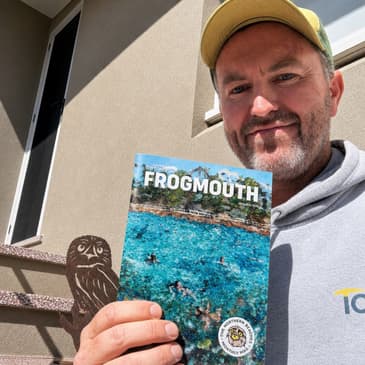
[00:00:00] Hi, I'm Chrissy Mack from Radio Northern Beaches and you've just tuned in to the Listen and Chat with Chrissy Mack podcast. This is the space where we pull no punches, sometimes a little controversial, sometimes downright outrageous and sometimes just packed full of information that is interesting to know. Listeners today, I have Liam Carol with me from The Tawny Frogmouth, our local magazine, which everybody loves by the way, Liam. How are you doing? Good, thank you.
[00:00:28] Welcome to Radio Northern Beaches. Now we're going to talk to you today about the Frogmouth and about how you got into it. But first of all, tell us a little bit about you and your family and being on the Northern Beaches. The Tawny is the Northern Beaches magazine, but I actually grew up in Balmain in the 80s, back when Wayne Pearce and Benny Elias and Leicardo, that sort of stuff. But my parents split up when I was about one and then Dad often lived at Newport. So I spent a lot of time on the beaches on weekends and stuff.
[00:00:57] As soon as I got my driver's license, when I was about 17, I was always coming to the beaches to go surfing. And so then as soon as I got my first job, I moved to Newport and then over the years sort of gravitated more towards Manly. You know, I think a lot of people are drawn to the Northern Beaches for different reasons. I meet some people through The Tawny that are like fourth generation locals and I think they're pretty heavy hitters. But, you know, it's a population where I think people are drawn here for whatever reason. They really are passionate about the Northern Beaches.
[00:01:23] So the local magazine sort of can tie into how passionate people are about this area. And those telling those stories, that's what I'm passionate about too, just local stories and being able to live here. Yeah. Simple as that, really. Do you have kids? Yeah. So one girl, Zosia. So me and Quinn, Mrs. Frogmouth, Quinn. We've got a baby, Zosia. Well, she's five now. But funnily enough, she's about the same age as the magazine. She was born in February 2021. We started the magazine in December 2020.
[00:01:51] But yeah, now she's a kindergarten Manly West. Manly West is the best. All the rest are a pest. Oh, wow. We live in Fairlight. So it's perfect. Yeah. Okay. So what got you to start the Tawny Frogmouth? Yeah. Well, it's as simple as the Manly Daily stopped printing. Well, that's the simple version of it. We do miss that. We terribly miss that. Well, it exists still, I guess, in digital kind of paywall form. Yeah, but nobody wants to pay for it. No, you can't pay. Tawny's free.
[00:02:20] Yeah, but the problem with that is the prices are going up and up and up. So not happening. Well, I think it was April or May 2020 and it just stopped printing. And from that, that was sort of like this vacuum of print. It was. We were sort of gobsmacked and there was this void. Void. And I mean, there are a couple other magazines on Northern Beaches that have been going for a while. You know, I went back into the void of old Manly Dailies from, it started in 1906, but it was the-
[00:02:49] My dad used to be a Manly Daily runner. Well, I think everyone has. And then the stories, the actual, it had like a larrikin nature. You know, it was fun. So if you read them from 1970, 1980, you know, I think one of the best ones, always some funny crime stories would always grab my attention when, you know, a pensioner steals some meat off and tries to do a getaway on their mobility scooter or something or stuff like that. It's gold. But then that was the catalyst. But it's a long story because I studied physiotherapy, Sydney Uni, and I got my first
[00:03:17] job with Jeff Pross, who lives around the corner from here, actually. He was like a Manly Seagulls physio legend. And so I did a placement under him and I was like, you know, this is epic. He's such a legend. So I worked for him for a couple of years at DY and sort of got more embedded in the community through that. But then I decided that, you know, everyone's just whinging at you all day as a physio. So after like two years, I'm not doing that. I'm sick of this. And I was young enough to get into an investment bank, global markets traineeship and became
[00:03:44] a commodities trader with gold and silver and oil and copper and worked in Sydney, Singapore and Shanghai. And that went for quite a while, but maybe age 34 or 35, I got fired from a sort of dodgy Swiss commodities company, which I've written a book about that, which is pretty funny, called Slippery. Okay. Where can you get that? Anywhere. Online's the easiest. But if you typed in Slippery, Liam Carroll, I don't cross promote it with the Tawny too much. It's got a lot of saucy language and it's about oil trading in Asia.
[00:04:12] So it goes to some pretty dark places, but it's pretty funny. It's got a bit of a cult following in sort of Europe and Asia. But then I did screenwriting. I wrote that book. I wrote another book called Sweet Dreams of Fanta, which is about Balmain in the 80s. You're a real author. Yeah. Like I wrote a couple of books, but you sort of realize that the author, and we try to support the authors in the magazine, but it's, you know, unless you get endorsed by the Oprah Winfrey show or something, it's about 10,000 hours of work for about five bucks of pay.
[00:04:40] So it's a tough racket. But the storytelling from screenwriting, which is all about eliciting emotion, that's more my push rather than journalism, which is just like trying to get the facts quickly, which I don't think any media is getting facts out there anymore anyway. No, it's pretty fast, isn't it? Whereas the Tawny, you want to tell stories, you know. So the example I always give, if there was like a car accident, like in front of Colorado or a cinema or something, if there was a car accident, that would be a news story immediately
[00:05:08] of like, you know, 12.45 p.m. Monday, you know, a car hit a pedestrian, you know, boom, boom, boom. If the Tawny was to do a story about a car accident, you know, it'd be, you know, who was driving the car and like, were they trying to get their mum to hospital? Was that intersection like a known black spot or something? Like you'd want to feel like fully invested in the story and have more information. Yeah, it's hard sometimes because you get the news and you get the facts, but there's always a story behind everything and you don't get it.
[00:05:37] And you often read something and you think, yeah, but why or what or how? There's more information there we want to know. Totally, yeah. And so having the story side of it makes it much more pleasant to read. And then you can sort of go back with a letter to you, I noticed, and say about this particular story. Yeah. Yeah. Well, I sort of compare it to, say you've got the ABC News versus Australian Story. So like the ABC News or any news would be like stabbing, stock market, something burnt down,
[00:06:07] the weather. You're like, what happened? Whereas Australian Story, they sort of go deeper into something and you find you're like, you're crying, you know, you want to volunteer, you want to donate. You know, it's just so different. So the tourney, because it's a monthly, it's a slower sort of burn. And then you might not read. So say there was a story, if you read the August tourney, hopefully some of the stories in that if you read it in 10 years time, you might get value out of it, you know.
[00:06:35] Whereas the newspaper within a day, it's obsolete. Yeah. And so that's another factor of like, if you're going to spend so much money and time to print things and deliver them, having a longer term value comes from stories. It doesn't come from just news per se. Well, people seem to love it and they write to you as well. Yeah. And it's becoming more and more popular. I know that I've been putting it out in front of the Coleroy Cinema and on my bench at the Coleroy Cinema and they're just flying out the door. So I hope you've brought some more with that.
[00:07:04] I did, yes. Good. And the Coleroy Cinema is a perfect example. Last month, just that open letter of, you know, Coleroy Cinema's in trouble. We need, you know, want to stand up for the cinema. And then people, it just wakes people up in a way that like the print is so tricky because all these digital marketing experts want to know every click and where the eyeballs go. You know, you just get the print in the community and you need to be in the community to hear the feedback from the community. So if you don't, if you didn't live on the Northern Beaches and you didn't know about
[00:07:34] the Tawny, you wouldn't think anything of it because it's not, it's not some TikTok sensation where they go, it's got a million views or something. Yeah, no, that drives me crazy. And plus the fact that you get reaction from the Tawny Frogmouth, whereas, you know, I've been in the digital area and yes, you get clicks and yes, you get this and yes, you get that, but you get no reaction and it's non-responsive. Or you get all this absolute garbage thrown at you and you think, why am I even on this?
[00:07:59] So when you pick up your Tawny Frogmouth and you read your Tawny Frogmouth, there's some great stories in there and, you know, it's a feel for the community. And it all ties together. So there's the very first Tawny, December 2020, basically my stepdad and I delivered all of them. Wow. There was a few Grommies got in early, six months pregnant, Mrs Frogmouth delivered a few. Oh my goodness. I think she did her back in though, she didn't really want to do that again. All right. But as soon as it started landing, you know, all these people were like, oh, can my kid
[00:08:29] have a job? And, you know, it sort of was instant feedback. So now there's 75 delivery soldiers. And why do you need more? Um, it's, I've sort of got the cantons. I call them cantons. It's pretty set. But, you know, if we started printing more magazines or it's a pretty transient because they're usually teenagers. And so they do it for a couple of years, but they get their 15 bucks an hour and, um, it's often their first job. And I write them up a little glowing review so they can move on to the next job. I lose a lot of them to Maccas. Uh, yeah. It's a standard. Yeah. It's a standard.
[00:08:59] But again, that's, so that's 75 walkers. It's 150 parents. It's, you know, 300 grandparents. Like immediately there's a network of that and they go, oh, have you checked out something that's happening here? Something's happening there. Um, you know, interesting things like there's a dementia choir at Seaforth where people with dementia, because my grandma had dementia, but they start singing songs and they can remember the songs and there's really, you know, um, so I would never know anything about any of that before the magazine.
[00:09:26] I was just like, I knew where the beaches were, where the pub was, you know, but the letterboxes, the kids too, when they deliver, actually deliver to letterboxes and you stop and look at the community properly and you'd learn all about the community and like, you know, different houses. And then you go, oh, maybe some bikies live in that house. Maybe, you know, like you sort of, it's funny, like how much more for that area, just the grit and the reality of everyone's got a letterbox and some people don't have letterboxes. That's very confusing when you're looking for the letterbox and they don't have one.
[00:09:56] It doesn't, yeah, not that. But it's like, we do live in the real world. So when you pick up a magazine and it's print, you know, first of all, it's not going to yell at you with like someone commented on your LinkedIn or something, or it's not going to start buzzing and beeping. And also it's not tracking you. Like the print isn't looking at you and building up some algorithmic profile of, you know, and listening to you and all this stuff that marketing people love that stuff because they
[00:10:25] think that they can like somehow psychologically manipulate someone. It's like the print is what it is. It's local stories. Everyone gets the same one. Yeah. You know, if the tawny was some digital Mark Zuckerberg led thing, if you lingered too long on the first page on something, the second page like update, it changes. It's like, you know, it's like something about, you know, pregnancy or weight loss or whatever. The next page changes, which again, I think that's what all the echo chambers and stuff, that's why the world's sort of going to hell. Yeah, pretty well.
[00:10:53] Because you get so down your lane and if you're not aware of it, because I sort of try to mess with my algorithm and I like things that I don't like and mess with it, you know, so it doesn't really know who I am. Yeah. I'm sure it does, but yeah, the magazine, it's the magazine, everyone gets the same one and you're linked by, you live on the Northern Beaches or you're interested in the Northern Beaches because sometimes they, you know, they fly out of here, they escape, you know, via travel to New Zealand or England or wherever, but anyone reading it has probably at some stage lived here or wants to come and live here.
[00:11:21] You know, we always try to put street names and any little detail where you're in the, like you feel like you're in the club, like you know about it. Yeah. Whereas like a broad reaching Sydney Morning Herald or Australian, like if it's meant for a bigger audience, that can work, but I think that local touch. It's not as personalised. Yeah. No, and even just putting a street name or just saying like Manly West right now, I'm sure a lot of listeners have some relation to Manly West or it's next to a cemetery, maybe they've walked through that cemetery.
[00:11:50] It's near what it, like if you just said a local school, it's kind of meaningless. Yeah. So really those details, I think, and it proves that you're a local. It's not some algorithm, chat GPT, copy and pasting the internet into some spit out, you know? Yeah. And the businesses seem to like it. They're supporting you. Well, that was the thing. Like if you want to compete on Google or on social media, like it's pretty expensive. An electrician explained to me once, like to be at the top of Google, like if someone in,
[00:12:17] if someone in Chroma right now, someone with their electricity and they want to get a plumber or something, if they Googled it, the actual top of Google, it cost an absolute fortune. You notice at the top there's advertised ones. And you can't trust that that much anymore. No. There's some real scammers on there. Totally. Yeah. And a guy, Brendan Ryan, who does kind of aged care as well as younger people, sort of financial help, like how to transition into retirement living and all sorts of stuff like that.
[00:12:43] But he was talking about some of the nursing homes and stuff where the information is totally false, but they can pay the most to be at the top of Google. So say if you're 40 years old and then your grandmother or your mother needs to go into a nursing home or something, it's quite a quick operation of trying to work out what the hell's going on. But even the information for that is sort of predatory. And there's no real way to regulate it via, because Google just takes whatever pays the highest money. And that's a vulnerable area. And vulnerable areas are, yeah. Yeah.
[00:13:11] So for the businesses, it's like, if you've got a good business that has a good product that solves a problem for someone and you're actually a local business where maybe you coach the netball team or you know people anyway, and they see your name or face. I love people if they actually just put their face. It's like, yep. Like Liesl Pierce, who does sort of, she's a family lawyer type person. Just, that's Liesl. We can help. You know, people probably know her, you know. And that's a simple ad. It costs a few hundred bucks. You need it for the whole month. Job done.
[00:13:39] And we have this thing, the Roll of Honour, next to the tie chart and just list all the businesses. So some people put that, the tie chart and the Roll of Honour, like on their fridge or whatever. Yeah, I like the tie chart. Yeah. And my son goes fishing quite a lot. The tie chart's very handy. Well, the funny story about the tie chart, in about the fifth issue, a bloke told me, he goes, oh, that's waste. You could have another ad there or something. So we did one. It was pretty early on. We just didn't put the tie chart in. Oh, you wouldn't be popular. Got some letters. Got about eight letters. You sell out. You wanker.
[00:14:08] I'm like, where's my tie chart? It's over. This make sucks. So you've got to put the tie chart in. That was a pretty instant feedback. Yeah, yeah. Because I think it's not only the fishermen, it's the surfers and all the others that use it as well. You've got the moon phases and stuff on it. I mean, anyone. And it's also the backdrop of it will be a lot of people send photos in. So certain photos really fit the tie chart backdrop. Yeah, I noticed that the photos are a great thing. And you also have on your front cover. Tell us about the front cover.
[00:14:39] Well, that was from the very get-go. The front cover, local artist. So again, I'm an author, I suppose. But I do really empathise, sympathise with creatives. It's very hard. And Australians with art. It's funny. It's hard to get an Australian to go to an art gallery. But say, Mambos from Northern Beaches or people, they love a bit of art. But it's hard to get them to buy art or to buy into the whole arts world without seeming like a bit of a tosser.
[00:15:07] Yeah, well, a lot of people think that art is just ultra expensive. But look around my walls. I belong to our art group. Down at the Grand, there's an art gallery for a local artist. And it's not that expensive. Not that expensive. And then so if it's on the cover, like basically the tawny cover just, it's, some artists have created a specific artwork for the cover. But some of them it's like, oh, that's something in their work that that's just perfect.
[00:15:34] You know, like that Manly Fairy one or something, that would be a perfect that you got there. But then also, so that's in 50,000 magazines. It's on the front cover. The name of the magazine is the Tawny Frogmouth, which is a stupid name. That's a great name. But it was designed, I think we were talking about this the other day, like for the very first issue, if we just called it Northern Beaches Monthly Magazine, people would go, piss off. Like they would sort of assume they know what's in it. But it was great feedback in the foot, like, what the hell is this crap? And then they go, oh, that's good. That's good.
[00:16:02] Like, you know, so it was sort of like a, you know, the Tawny Frogmouth as well as a bird, you know, bird of the year last year. So it should be bird of the year again every year. But it's just a cool bird, you know, that sits in the trees and looks at everyone, but camouflages. And so it was a perfect emblem for both fronts. But basically the cover is just Tawny Frogmouth in, you know, it's sort of letters and font, but then a local artist on 50,000 of them.
[00:16:28] And then if people like that art, then we always do an interview with the artists as well. That's just a huge sort of momentum builder for the artist. And also some of them, like, I'm sure they're dealing with their own families or friends who, you know, they're an artist. Like, they sort of roll their eyes, but then it gives them this credibility. And then if they can time and have an exhibition in the sort of aftermath of the magazines and just start selling it their own community. Like, it's a huge way to just feed into it.
[00:16:56] And it's also, you know, not to slate any other publications, but I don't really like seeing degrade celebrities on the covers of magazines. It makes me feel a bit gross. I'm not going there. All right. So who have you got on the magazine cover coming up for next month? Well, so Stephanie Galloway. Well, I don't want to give too much away. You say Stephanie Galloway, who, again, just awesome local artist. And it's tricky.
[00:17:23] We only have, so we do it monthly, but we take February off. So we do 11 a year. There are so many more artists on the beaches. So, you know, there's a lot of artists that often contact me and you're like, just got to try and work out. Yeah. We have a huge community of artists. We have a huge community of creatives. We have writers and we've got a writers festival and readers festival coming up very shortly, actually. But if you look across on the other wall, that's Stephanie Galloway's. And on the wall, you can't see at the moment. There's another one there.
[00:17:52] So my house is full of local artists. Yeah. I just love them, plus my own watercolors, et cetera. So it's a great way of helping the artists out by just making people where they have some of the most amazing artists on the northern beaches. Yeah. And again, it sort of feeds into a community event. So there is an artist that's a human being that maybe has a studio that you can go and can talk to people. Exactly.
[00:18:17] It's not some NFT or whatever those stupid things used to be, those digital artworks and stuff. Yeah, no, no, no. And there's a lot of stuff now with AI generating things. I think that's just going to burn out so quickly. I like it. It kind of looked cool for two minutes, but it gets over. And it's like a lot of things with AI, it's really easy. Yeah. So if you're not that competent, you can sort of pretend to be. Exactly. Whereas the people that put the time in and really have the craftsmanship and enjoy doing it, like Mrs. Frogman, too, with the watercolor. I see her. She loves watercolor.
[00:18:46] And it's a really, you've got to put the time in. I mean, that's- It's the easiest one to do. Not. Oh. I prefer oil so much. Like, I do my watercolors, as you can see. Yeah. Oil is a lot easier. And I've just started dabbling in acrylics. But Stephanie's paintings are amazing because she uses beeswax and things on the top of them.
[00:19:13] And as you can see, the flowers around the birds just pop out. Totally. She's just the most amazing, amazing artist. So it'll be interesting. And I think she's also in the Archibalds. Yes. At the moment. Yep. So, and then I think she's also going to have a show shortly. Yep. So that's timed perfectly. So she's one of the ones that's sort of lined up really well. And that's what, if we could do that every month of the Frogmouth with the artist having, it doesn't always work that way.
[00:19:41] But again, that's just the best way for the artist to show off. Yeah. For people to buy into the community and go to the exhibition and all that sort of stuff. And then, and from that, you know, you're in the club, you know, and then maybe you won't go to Ikea and buy the first thing on the wall and buy that triangle building of New York that everyone's got. Yeah. You know? No. Or at least you'll appreciate. Real art. Yeah. And it's, you know, there is artwork that sells for tens of thousands of dollars. But as you're saying, like, it might be $200, $800. Yeah.
[00:20:10] And it lights up a room. Well, at Melanie Ferry, I walked past it at the gallery down at the Grand. And that's done by one of our group. But that was prior to me joining that group. And I couldn't walk past it. It was just like, it was so realistic and so great. And I thought, oh, I'm not going to be able to afford that. And I looked at the price tag and it was only $200. Yeah. It's like, that's mine. I don't know. And you're trying to get that.
[00:20:40] We should probably have put prices in the magazine of what their cover art or. I think it would shock people. Yeah. How affordable it is. Yeah. So, yeah, everyone go and have a look. It's just amazing. And then your mates with the artist too, which is also, like, cool. Well, Stephanie actually came. She brought them. Because they're quite large, these things. And she brought them here and she put them up on the wall for me. But when she came in, I have a glass doors across the front and a pond out in the front.
[00:21:09] And so as she was hanging the parrot, it's got yellow flowers around it. And my orchids were out. Water orchids were out in the front. They were all bright yellow. And it was just, it was amazing. Oh, yeah. Yeah. Yeah. Yeah. Yeah. She came out and did it. Put it all up. Yeah. They're goers. Yeah. It's not easy being an artist. But, yeah, being in the community is just wonderful. And learning about the community. And that's what I find different about Frogmout.
[00:21:36] It's, yeah, you've got that community feel about it. You've got those stories. It's not just advertising. It's a great magazine. People love it. And if it is advertising, like I like them, like their local businesses where, you know, I know the owner or like I sort of believe we haven't had, we'll see what happens, but like Harvey Norman hasn't sort of tried to just have like 50 pages of ads in there ever. There's certain things about some of those mainstream publications where it feels like
[00:22:04] it just, it's owned by a certain billionaire or something. Well, I actually rang one particular one and talked to them about a story. And I was told, oh, you can't have editorial unless you pay for an ad. Yeah, yeah. And like, seriously? That's not community? Yeah. And again, I mean, it's the media in general. I mean, I'm just new to the whole game. But I think back in the glory days where you had maybe tobacco advertising or something,
[00:22:35] and then you could have newsrooms full of journalists because it was always paid for by tobacco. Like there's weird ways of things being paid for, but it's trying to work out that balance of, you know, this is just genuine. And the stories. But yeah. Yeah. It's got that community feel. Yeah. Yeah. And it's fortunate because, I mean, I'm sure every community has this similar thing, but the Northern Beaches in particular, there's so much going on.
[00:23:00] Like between, say, Manly Dam, all the beaches, Brookvale Industrial, the Cromer Industrial, Monerville, like there's things happening. So there's always stories that are genuinely interesting. There's all these genuinely like go-getter people up to all sorts of stuff. And do you find other than your walkers, there are people letting you know what's going on? Yeah, totally. And I mean, so probably the best magazine possible would just be all letters.
[00:23:27] And I cop a bit of flack because some people, the words climate change, even just those two words, you're going to get people fired up. Yeah. And it's, you know, I've done some financial modelling. I've studied a science degree, physiotherapy is a science degree. Like the experts on all this science, it blows your mind how much everyone's an expert on the environment. But I sort of let, if you're a local, I'm biased towards locals.
[00:23:52] So if you're totally, you know, we've got to, climate change is this massive urgent thing, you know, boom, done. What are you going to say? If you're someone that's all nonsense, it's all crap, you know, as long as you are a local and you genuinely heartfelt believe what you're saying, I'm going to support that. But some people try to say, yeah, I can't believe you published that. I can't believe you published this and blah, blah, blah. Everybody's got an opinion and everybody has a right to an opinion. It doesn't mean everybody agrees with it, but there's no reason why you can't have both sides and both sides. That's healthy.
[00:24:21] If you're clearly slagging someone and it's like out to get someone. Oh, that's a different thing. It can be funny. But no, but I'm just biased if you're just from the beaches. I'm not trying to push like, you know, so e-bikes is a classic, you know, e-bikes, obviously if they're used well, it's going to change the whole infrastructure of transport. But if there's just, you know, 50, 16-year-olds going 60k an hour on a pedestrian crossing and taking out old ladies.
[00:24:47] I walked out the front door of a shop yesterday and this e-bike came flying past me. I was like, that was so close. Yeah. And it was only one e-bike, not a group, and he wasn't going extremely fast. But if I'd have been five seconds earlier, he'd have collected me. No, no. Well, and also, so say as people get a bit older, their mobility's not good. They can't top out of the way quickly. Or when my little one was like two.
[00:25:16] Now, she's only two foot tall. Then those big fat wheels on those things, they would just motor over down at Manly or whatever. But again, it gets, some people are so fired up to support e-bikes and some people are so fired up to just crush them all. But there's a place for everything. Yeah, yeah. As long as it's used properly. So I'm trying to find that balance, you know. The letters often lead into the stories because then people will point out certain things that are worth pursuing.
[00:25:40] And then I like if people aren't afraid to be a bit ochre and a bit Aussie in how they write. It doesn't have to be really formal, you know, Pulitzer Prize winning language. You know, the ochre sort of, the oracle we call her. She doesn't want a real name, but she always sends pretty funny letters in about all sorts of stuff. And Bert grumbles. Oh, yeah. Bert grumbles. I read him and I go, oh, my dear. Yeah, no. That's gold. All right, Liam. Look, it's been wonderful talking to you. Thanks for coming and talking to me. Legend. Good luck with your frog mouth.
[00:26:10] And hopefully it gets bigger and better. Or we get it twice a month instead of once. Yeah, well. Well, it's a pretty big undertaking once a month. Yeah. I don't know how the Manly Daily did a daily thing for 80 years. They had a lot of stuff. Yeah. And they've got big print and so forth. But even now with the papers, they're not as good as they were. Like the fact that there's a Sydney Morning Herald and a daily telegram every single morning, like they should get an astounding ovation. Like it's incredible to produce that. To produce it. Yeah.
[00:26:39] And then they do one spelling mistake and everyone yells at us like, you try and create a whole newspaper overnight. Good luck. Yeah. And not get something wrong. Yeah, yeah. It's amazing. All right. Well, thanks so much for coming in and talking to us. Cheers. This is Liam Carroll from the Tawny Frogmouth and you're listening to me on Radio Northern Beaches. Don't forget to follow, like and share. Stay safe and I'll catch you next time.