
[00:00:00] Hi, I'm Christine McCormack from Radio Northern Beaches and you've just tuned in to the Listen and Chat with Christine McCormack Podcast. This is the space where we pull no punches, sometimes a little controversial, sometimes downright outrageous, and sometimes just packed full of information that is interesting to know.
[00:00:18] If you tuned in to the Reserve Bank's press conference or have been keeping an eye on the news, you might have caught a pretty telling moment that made every small business owner and everyday Australian freeze in their tracks. ABC's business editor, Michael Jander, stepped up and asked Reserve Bank Governor Michelle Bullock, point blank, a question that I reckon almost everyone listening at home or in their car has wondered at some point.
[00:00:47] His question was, your survey shows inflation is the biggest concern for most Australians, but it also shows most of those Australians think you're contributing to it by raising interest rates. Do they have a point? The room went completely silent for seconds. You could feel the tension through the screen. Governor Bullock chuckled, gave a swift denial and called it a classic case of correlation versus causation.
[00:01:14] She claimed that may look like what's happening, but it isn't. Now in central bank speak, what she means is interest rates aren't causing inflation. They're the RBA's medicine to try to cure it. From their textbook view, interest rates aren't counted in the standard inflation basket. So rate hikes don't directly push up headline CPI figures. But with all due respect to the central bank, that answer feels completely out of touch with reality.
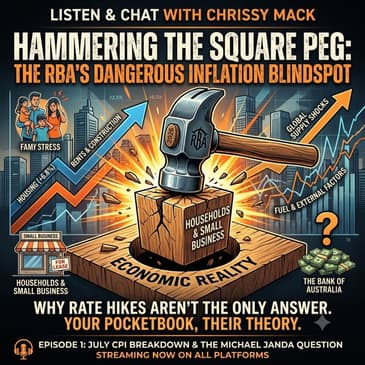
[00:01:44] In front of her own data, housing prices are falling further than expected, jobs are disappearing and the cost of living is soaring. Yet the RBA keeps swinging the same blunt hammer. You cannot keep hammering a square peg into a round hole without it splitting and shattering. And right now, Australian households and small businesses are the ones shattering. Today we are stripping away the academic jargon.
[00:02:12] We are going to look at the facts, correct the myths and explain why the RBA's theoretical playbook is breaking down in the real world. Let's talk about why the RBA claims raising rates lowers inflation and why that logic fails on the ground. In standard economical textbooks, there are two opposing forces when rates go up. Force one, the direct cost.
[00:02:38] Raising rates instantly inflates the cost of doing business. It drives up interest rates on business loans, inflates commercial rents and pushes up the cost of goods because producers pass the higher overheads down the chain. It doesn't reduce material costs, it inflates them. Small business owners carrying debt or overdrafts have no choice but to pass those higher borrowing costs right on to us at the checkout just to survive.
[00:03:08] Force number two, the demand squeeze. The RBA believes that if they squeeze households hard enough, people stop spending, forcing business to absorb the higher costs or lower their prices. Well, here's the fatal flaw in the RBA's logic. We are already at the bottom of the barrel. Force two only works on discretionary spending. The luxury stuff like holidays and new clothes.
[00:03:36] But when people have zero cushion left and interest hikes hit essential costs like rent, groceries and supply chains, businesses have nowhere left to go. They can't just absorb a percentage jump in their loan repayments or freight costs. Instead of lowering prices in the real world means businesses go under.
[00:03:58] Local employers close their doors and prices of essentials keep rising anyway because people still have to eat and keep a roof over their heads. Even if mortgage repayments aren't actually in the CPI basket, they strip real cash out of family budgets every single month. And what about the global shocks?
[00:04:22] War in the Middle East, global fuel spikes and supply chain disruptions are completely out of control. Lifting interest rates in Sydney doesn't lower the prices of oil or shipping containers in the Persian Gulf. It just punishes local families for global chaos. You will often hear economists talk about headline inflation versus underlying inflation or what they call the trimmed mean.
[00:04:52] Let's explain what this actually means in plain English so you can spot the spin. Think of headline inflation as your raw shopping receipt. It tracks the total price changes of everything in a standard household basket. The problem is it jumps around like crazy. If a cyclone destroys a banana crop or a war strikes petrol prices, headline inflation rockets up, even if the rest of the economy is quiet.
[00:05:19] So the RBA uses underlying inflation to make their rates decision. How to picture underlying inflation? Well, imagine taking a list of every single price change in Australia, sorting them from the biggest price drop at the bottom to the biggest price surge at the top. The statisticians throw out the top 15%, like temporary fuel hikes, and the bottom 15%, like clearance sales.
[00:05:47] What is left in the middle 70% is underlying inflation. The RBA looks at the middle core, things like rents, tradies costs and local services. And if that middle part is rising, they raise interest rates. The tragedy here is, by raising interest rates to fix the middle part, the RBA directly inflates commercial loans, builder finance and landlord mortgages,
[00:06:13] which actively drives up the very middle core prices they are trying to bring down. Now let's have a look at productivity and the stripping of Australian industry. The RBA and politicians love to complain about the lack of productivity in Australia. They tell us workers aren't producing enough per hour. But let's ask the honest question here.
[00:06:35] How can an economy build true productivity when governments have spent decades gutting our productive sectors? Since 1960s and 1970s, successive Australian governments have stripped away tariffs and exposed local industries to global undercutters. We watched structural de-industrialisation decimate our sovereign base. Textiles, clothing and footwear.
[00:07:03] Once a thriving local employer, virtually exported overseas. Automotive manufacturing, completely dead with the exit of Ford, Holden and Toyota. White goods and heavy machinery. Local production of appliances and industrial tools shrank to almost nothing. Cottage industries and local processing. Cottage industries were people at home making things. That was pretty well outlawed.
[00:07:33] Small scale regional manufacturing was replaced by cheap imports. When you dismantle your sovereign manufacturing base and rely almost entirely on imported goods and a service economy, you become hyper-vulnerable to global supply shocks. Blaming workers for a productivity crisis after systematically dismantling the nation's industry engine is purely shifting the blame.
[00:07:59] Finally, let's address the comments about young first home buyers. To hear central bankers express detached nonchalance about failing house values or skyrocketing mortgage rates hurting young buyers' beggars belief. To be factually accurate, the RBA does not target house prices. By law, Parliament gave them a statutory dual mandate. Maintain price stability.
[00:08:28] Keep inflation at 2-3% and keep full employment. In plain English, the RBA's legal mandate is to protect the purchasing power of the Australian dollar, not the housing affordability of a 25-year-old trying to buy their first unit. They view housing as collateral damage in their war on spending. If young people are locked out of the market, or if families are forced to sell their homes because of rake heights,
[00:08:56] the RBA considers that is a problem for the federal and state governments to solve. How? Through housing supply, tax policy, and immigration. Not their problem. That brings us back to the fundamental truth of where we are today. Right now, the Australian people are the money behind the Australian economy. It isn't a magical pot of funds in Canberra and Martin Place. That money is coming directly out of our back pockets.
[00:09:26] Everyday workers, small business owners and families, we are the Bank of Australia. Which brings me back to the core questions we've tackled in my previous episodes, like rewriting the housing blueprint, building your future, and our breakdown of severe loss of government revenue from decades of privatising essential state assets. When governments sold off our power grids, our ports, our public utilities, and our public infrastructure to private corporations,
[00:09:55] they cut off their own non-tax revenue streams. And ever since, whenever the government needs money or wants to tackle an economic crisis, where do they go? Straight to our back pockets. Now I want to ask the hard question. When are state and federal governments going to get a job? When are our political leaders going to stop relying solely on taxing households
[00:10:20] and squeezing homebuyers and start reclaiming or initiating public-backed enterprises that generate real sovereign revenue for this country? Where is the leadership with the tenacity to build public housing models that bypass corporate middlemen, invest in state-owned infrastructure, and build productive industries that actually return money to the public purse?
[00:10:45] Then, and only then, will the Australian people look to them as true leaders of the country. Because until a government steps up to build real, self-sustaining revenue, instead of treating the Australian public like a bottomless ATM, they aren't leading, they are just managing our decline. On Wednesday, 29th of July, the fresh CPI report dropped from the ABS.
[00:11:12] And it delivers a massive reality check to everything we've been discussing today. Headline inflation fell 3.8 lower than the market expectations. And why did it drop? Because global automotive fuel prices fell sharply once again. And I want to note right here, this is the third time now. This is the third consecutive time we have seen inflation cool off due to external global energy and trade factors.
[00:11:40] Not because the RBA slammed everyday Australians with interest rate hikes. Meanwhile, underlying inflation remains stuck at 3.6%. And what happened to housing costs? The very sector most crushed by high interest rates? Housing inflation surged 6.8% with electricity, rents and new home construction driving the increase. Builders explicitly cited passing on higher labour and finance costs.
[00:12:10] High interest rates make it much more expensive for builders and developers to borrow money to build new homes. That slows down construction, squeezes housing supply and dries up rents and build costs, which go straight into the inflation figures. So while the governor is technically right about the textbook theory, for anyone paying off a mortgage or trying to pay rent, those higher rates create very real cost pressures of their own.
[00:12:40] What more proof does the RBA need? Three times now, the data has shown the exact same story. When global supply shocks settle, inflation drops on its own. But when you keep hammering domestic borrowers with rate hikes, you don't lower the cost of living. You just keep driving up housing, rents and business overheads. The RBA can deny it all they want, but everyday Australians know what they are feeling.
[00:13:09] When interest rate hikes inflate the costs of doing business, push small business to the brink and drive up rents, the tool itself becomes part of the inflation problem. It's time for the RBA to look at the pattern right in front of them and stop hammering the peg before the whole board shatters. Now again, I express, these are my opinions and not necessarily those of anyone else.
[00:13:35] All right, I hope I've given you a lot to think about and talk about and debate and maybe disagree with. Don't forget to follow, like and share. Stay safe and I'll catch you next time.