
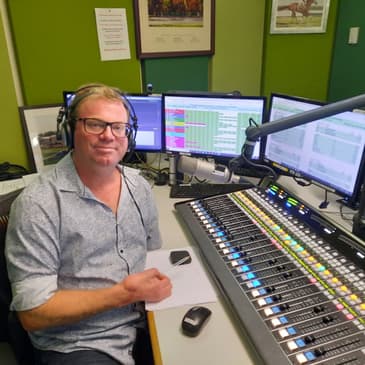
[00:00:00] Hi, I'm Chrissy Mack from Radio Northern Beaches and you've just tuned in to the Listen and Chat with Chrissy Mack Podcast. This is the space where we pull no punches, sometimes a little controversial, sometimes downright outrageous, and sometimes just packed full of information that is interesting to know. A quick disclaimer before we begin. The following segment discusses topics related to gambling.
[00:00:24] Radio Northern Beaches advocates for responsible gambling. Listeners discretion is advised. Listeners, today I have in the studio with me Stephen Harrison. Now Simon has been on our Grit Diaries program and told us about his life and an accident he had on the train tracks. And if you want to listen to that, go off to our Grit Diaries programs and you can hear the whole story. But today we've got him in because he is a presenter on another radio station, not Radio Northern Beaches.
[00:00:53] And he is going to tell us about his program. Now I know nothing about horse racing, but I'm really interested in how he's going to tell the story, how he got into it, why he got into it, what happened and how he loves it and what the extension of that is. So welcome Simon. Thank you, Chrissy. Thank you for having me along. It feels like a privilege to be here with you.
[00:01:15] Thank you. So for our Radio Northern Beaches listeners, let's start off with how you got into horse racing. Well, it's funny. I suppose it really began with the Melbourne Cup and of course the annual tradition of putting a bet on and the families. It's the race that stops the nation. And as a kid, every year I looked forward to the Melbourne Cup and I'd have a look in the form guide and see who was running and I'd try and pick the winner.
[00:01:44] And I enjoyed trying. I didn't have too much luck until 1995 when I was 15 years old. And I backed a horse called Doremus. I'd seen that it had won the Caulfield Cup that year. I thought, ah, there's a winning chance. So I'll have my pocket money on that. But of course I was too young to bet. So I'd get my dad to go and put the ticket on and he'd head up to the tab. And then after school I watched the race and the horse, low and behold, won.
[00:02:10] And I turned my $20 bet, which was $10 each way, into a collect of about $72. And of course I felt like I was the richest person in the world. I thought, how long has this been going on for? Good God, I've cracked the code. You watch me go. And of course it took me about another 20 years before I found the next Melbourne Cup. But that's where the love for horse racing began. And it began with just once a year with the Melbourne Cup.
[00:02:36] As you mentioned before, I had a catastrophic accident when I was 15. It was about nine months after that Melbourne Cup, in fact. And I had a railroad accident up at Wurunga and wound up getting run over by a tangara, losing my left arm and my right hand. And through painstaking microsurgery, the surgeon did a transplant from my left fingers to my right. And it was four months in hospital.
[00:03:02] And it was obviously a life-altering incident, which put me on another trajectory. So once I finished school, I moved out west. I was out in Parramatta and I was on a disability pension. And I was in the cycle of welfare. Centrelink payments was where my money came from. And luckily my father was paying the rent on a little one-bedroom unit that I was living in. I simply couldn't have done it without his support. But the people I hung around with were all a part of that welfare click.
[00:03:31] We used to go to the charities to get food vouchers to get food. We used to eat at the soup kitchen and the barbecues that they had in the park for the homeless and the people that were on the streets. And I thought that was where my future was. I thought, I'm never going to work. I'm a pensioner here, a disabled pensioner at the age of 19. This is it for me. And I was just living day to day and trying not to think too far ahead.
[00:03:56] But one place where people that are in that situation in life find themselves hanging out in is the TAB or in the pub in the TAB, trying to turn what little they've got in their pocket into a bit more so they can survive. Because gambling provides a solution, a short-term solution, if you're lucky enough to get you from one paycheck to the next.
[00:04:22] And I like the horse racing, so I combined the two and I thought I'll try my luck on the punt. And I wound up spending a lot of time in the TAB and I just sort of developed a real passion for it and I got into it and I'm learning the races and I'm learning the horses and I learnt my basic Australian geography from hanging out in the TAB. I learnt more there than I ever learnt from my geography lessons in Year 7 and Year 8. From where all the towns in Australia are.
[00:04:51] You know, sail, where's that? Balaclava, where's that? Esk, where's that? And I'd learn it from the colour-coded signs on the wall in the TAB as to what region of Australia they were in. Whoever thought that you'd get an education on geography on Australia in a tab? And every punter I know says the same thing. I learnt my basic Australian geography in a TAB. But lo and behold, to sort of cut a long story short, the radio station who broadcast those races, 2KY,
[00:05:19] was only 100 metres or so behind the TAB that was when it was on Church Street back in those days in Parramatta. It was on Argyle Street opposite the train station. And I met a bloke that brought me through the door, took me into a spare studio, much like this studio that we're in right now, and trained me up in the art of race coordinating, which is like air traffic control for the AM racing band. Throwing from one race to the next all around Australia, looking seven minutes ahead,
[00:05:48] always thinking seven minutes ahead to where those next races were coming in from. Get your race results, move off. Next one comes in, move off. It's like planes coming in on a tarmac and taking off and just, you know, organising them. And that's the job that I've been doing for 23 years. So I am a race coordinator for the National Racing Service. Our studio is not too far from where Radio Northern Beaches is. We're down at French's Forest with Sky Racing. And my station now is Sky Sports Radio,
[00:06:17] but was the old 2KY at Parramatta. So that's been my role and my job. I basically put a lot of races to air that people bet on through the TAB. That's what it is. Wow. And I didn't even know that was there. Well, I'll have to come and visit you. Yeah, it's up near the Northern Beaches Hospital. They're in there. So Sky Racing Television that do all of the televising, of course, and that's right around Australia and through pubs and clubs and all overseas as well, in fact.
[00:06:44] They're upstairs and in the radio studios are downstairs. I met Simon at a business summit and I remember him saying to me that gambling ruins so many lives, but it saved mine. Tell me about that. That's the irony. And I tell people I'm a walking contradiction. I really am. Normally for most people it's a dark thing. And believe me, for most of the people I was rubbing shoulders with in the TAB back then, not too many of them could say gambling saved them.
[00:07:14] I reckon I would just about have been the only one, in fact. But I went in there and funnily enough it became a career path. When I lost my left arm and I lost the hand and all of that was gone, there goes any career in manual labour. There goes any chance of picking up a wheelbarrow at the construction site and putting the hard hat on. That future is gone. But I always knew that I had a voice and I could use the voice. And I once heard somebody say,
[00:07:42] if you can't use your hands and you can't use your voice, then there's no job you can do. And I've racked my brain with it over the years. I think that's a pretty true statement. So I knew straight away that it had to be the voice. And everyone down at the TAB used to say, you know, get into race calling. And that was what I originally wanted to do. I thought, I've got the voice and now they're off and racing now and coming round the turn. And I thought, I can do that. You know, I'd say, I'm good. And of course, there's a lot more to it than just building it out
[00:08:11] in front of your mates after half a dozen schooners for a laugh. But I contacted the station, met someone, said I wanted to get into race calling. I realised then to do that, you've got to be able to get out to the racetracks and they can be far away. They can be in the country. I didn't drive at the time. Logistically, it was just never going to happen. So the studio was where it was for me, which wasn't the calling. It was the coordinating. And after a while, six months, it became obvious that that was probably where my future was.
[00:08:40] And whilst I work with the callers on here and I throw to them, I'm the coordinator. So it began with the TAB and getting out of the tab and into the radio studio. I got a job out of it. And I've always had an interest in having a punt and watching the horse races. But it's the gambling dollar that fuels the TAB, which pays my paycheck, which puts me on air and gives the races to the public. And they punt and that goes back to the TAB. And that's the cycle. So gambling, I'd be one of the few.
[00:09:11] And in particular, the horse racing industry. It's the horse racing industry, really, that reached down and pulled me out of the gutter in my time of need. I remember when I was young, my mother used to love to sit there. She never bet, but she used to love to sit there, especially with the dogs, and pick the names of the dogs. And nine times out of ten, those dogs won. But if my father put a bet on it, it never won. It's crazy. And he tried that with the horses as well.
[00:09:40] She was really good at picking the horses. But if he ever put a bet on it, it never won. So she was just lucky with picking the names as long as there was no money on them. That is what they call the kiss of death. Some people have been kissed by the good fairy and they just, whatever they touch, turns to gold. My mother-in-law was like that. It drives me mad. I spend time doing the form. She'll like the look of the jockey or something. You can pick the winner at 20 to 1. And I've spent all this time on the form and doing my dog cold.
[00:10:08] Some people are blessed with a bit of luck when it comes to the punter and horse racing. And a lot of people like me are generally cursed. But it doesn't stop us from trying. Yeah. Again, I remind people, don't overdo it. Just put a little bit aside if you're going to do something like that and don't overdo it. Gamble responsibly, as they say. And I think that's probably one of the greatest oxymorons I've ever heard in my life. So tell me, do you get out to the tracks much? Oh, I knew when I was younger and I'd always go, not so much for work,
[00:10:38] but to socialise. And quite often I'd go down to the... I used to like going down to Gundagai once a year for their annual Snake Gully Cup meeting in November. And the same bunch of mates would go down there and we'd book a caravan park at Tumit, which is a beautiful little town at the foot of the Snowys. Lovely part of New South Wales down there. So I did that every year. These days I don't so much. I'm just pretty busy with the studio work and everything I do outside that. So I don't get to the track these days too much.
[00:11:07] But I'm trying to organise another trip to Gundagai at the end of this year. I haven't been for a few years and it'll be good to get the old gang back together and just get out of the country, New South Wales. And horse racing, it is so typical of any country town in Australia. It is quintessentially Australian that most country towns will have a racing track and they'll have their annual cup meeting where all the locals and the townsfolk turn up for the day and they get dressed up. And of course, the pubs are raging that night in town.
[00:11:36] It's a part of Australian folklore and history. And it's so good to see that it still continues. I love country racing, the real grassroots aspect of the sport. Well, I've only had one experience with that and I actually worked for Optus at the time and they did a special day out where we got on a train and we went out country and I can't even remember where it was now, but it was about an hour out also, hour, hour and a half. And we were taken to the races and these are in the days where you're allowed to do that sort of thing. They don't do that anymore.
[00:12:05] And what got me was the atmosphere. You know, I finally put a bet on something. We weren't required to do that. We were just there for the day, for the fun and the food and whatever. But we were allowed to put a bet on if we wanted to. And there was something that had my name and I don't remember now. Chrissy's like, well, something like that. So I put a bet on AI1. What did it pay? I do not remember. It wasn't a lot of money. I didn't put much on. I think I might've put a couple of dollars or whatever. But the thrill of it was fun. But immediately,
[00:12:35] I think it might've been my training or my childhood, said, that's it. You've had your fun. That's enough. Which is a good sense to have. I think that came from my father constantly, you know, having a go at the pokies. But he was one of these people that he put a few dollars in the pokies and win. And that used to drive me mad because I can never win on the pokies. I tell you what, there is one simple litmus test to tell if somebody is a gambler or not.
[00:13:05] Some people have just got that gambling streak in them. Others are sensible. But some are just a bit bitten by the bug. There is one simple test and one question that I can ask that will tell me straight away if you are a gambler or you're not. But, okay, Chrissy, so this is the question. Would you rather win $100 or nearly win a million? I think I'd rather $100. You're a non-gambler.
[00:13:35] There you go. That's the smart answer. And that's the right answer because you're better off. If it's a sure bet, yeah. You are better off with the hundred bucks in your pocket. But for the gambler, the eyes light up. Hang on, hang on. Nearly? Nearly with a million? So what do you mean? There's a possibility. They hear the positive instead of negative. Yes, and it takes you to the very stratosphere where the adrenaline of the punt will take people. And that's when the blood starts to, you know, that's the gambler.
[00:14:05] And that is a surefire. For me, I'd rather nearly win a million because I've just got that in me. But it's a good question to ask. It is. It's a perfect question to ask. If you asked a few people at a party, you'd probably get a few different results. Most of the males you answer would probably say, I can win a million. How do I do that? Yeah, yeah. No, as I said, I think from my growing up and watching that all happening, it's like, no. No, and we're on a community-based, you know,
[00:14:35] on a community-based radio station and on a podcast. I'm not promoting irresponsible gambling, but it's a good measuring stick, that one. It is, definitely. So what about the horses? I mean, you get out and you've seen the horses and you get the atmosphere and whatever, and then you're in the studio and you're sort of doing your calculations. How do you feel about the horse? How do you get a feel for a horse? How does that work? Well, I've got friends of mine that are hands-on with them.
[00:15:05] They're at the track. They're up at track work every morning. They're out on the horse studs and they really are horse people and they understand them and they know what they're looking at. So friends that can pick them at the sails and their yearlings and just know what they're looking for, the big shoulders and the strong legs. I'm clueless when it comes to being able to, by looking at a horse, you know, most of them look the same to me. I do it on form. Like most punters, I'll do it on form and look at what races they've been in, where they finished, what weight they were carrying,
[00:15:35] what barrier they're jumping from, what the conditions are. So I'm a form punter, but there are people out there that will go off-site and they pick them from the mounting yard. They call them the yard watchers and some of them are very clever people, very, very clever people and you'll find that the big traders and the big buyers that spend money and they buy these yearlings in the hope of getting the next champion racehorse will have people working for them that know exactly what they're looking for and they're all trying to outbid each other
[00:16:03] and hopefully pick up the next champion, hopefully pick up the next far lap. Although I think for memory, he was pretty unfashionable through the sales yard and he wasn't sold for that much money. So that's the allure as well because you don't know how good they're going to be and sometimes there's been stories of horses that really don't look that attractive to the eye and they go for peanuts and they turn out to be a champion and vice versa. You spend a lot of money on one that looks like it's indestructible and they don't win a race. So that's the mystery
[00:16:32] and that's the allure. It's a bit like gold panning. You don't know what you're hoping. There'll be a speck of gold in that pan but you just don't know what it's going to turn up. I recall a while back, I think it was during the Melbourne Cup run-up or before the Melbourne Cup or whatever, I think it was a few years back, years just disappear in my brain these days, but it was a horse that did really well. The horse owners had put a cooperative together and it had done well. Do you see many of those? Yeah, yeah, your syndicates. Yeah.
[00:17:02] I don't know what you're thinking of. There was a horse called Maccabi Diva who won three Melbourne Cups and how she became named was she was owned by a man called Tony Santik who was a tuna fisherman in South Australia, ran a big tuna fishing company and he had five ladies that worked for him and their names were Maureen, Kylie, Belinda, Diane and Vanessa and he took the first two initials from each of their names and formed Maccabi Diva. Oh, really? That's interesting. Yeah, yeah. That's how the name came about.
[00:17:32] But there are other stories where you get friends together or people together and you could have a syndicate of 100 people. So they're all throwing in. So it doesn't cost as much but the thrill of winning is the same. Cheering your horse on to be first past the post is the same whether you own 5% or 20%. Cool. I don't think it was Maccabi Diva because I would have recalled that because I know that name well. But yeah, I think it was only about five or six people but they did quite well. And yeah, the joy that they took from the win
[00:18:01] was fun to watch on TV. Oh, to be a rollercoaster. Yeah. Well, that's the dream, isn't it? That's the dream is that you will get that next champion racehorse. And everyone lives in hope, of course, when they're unraced or they're two years out, they're all living the dream and quite often the dreams fall over as the season stick by. But, you know, you've got to be in it to win it, I suppose. So what about the owners? Do you have any opportunity to meet owners, talk to owners
[00:18:30] over the period of your career? Yeah. Yeah, absolutely. In fact, a couple of, I'll tell you what, tell you a story, Chrissie. I have coffee every morning at a cafe in DY and I got to meet two brothers, both retired, time and age now, Richard and Philip. And they've been sort of hapless horse owners for years. Got into lots of horse, but never really had too much luck. But recently, they bought into a horse up in Queensland that's just won three races out of six starts and it's the only horse
[00:18:59] they've ever had in their life they've been in front of in terms of winning prize money. So they finally got onto a good one. And every morning at the coffee, I ask, how's your horse going? Its name is Kaluakoi. It runs up in Queensland. Oh, that's a nice name. I like that. it's a nice name. It won the Ipswich Cup and it ran third in the Grafton Cup and it's done really well. And it becomes a great source of conversation. So there's just a couple of community members that are owners that I bump into. But of course, I know a multitude of owners through my racing game and people I work with
[00:19:29] and people have asked me, would you ever go into ownership? And I tell you what, I got scared off when I was young. I once heard somebody say a wise man once said, if you're in any way a sore loser, don't go into owning racehorses. And straight away, I said to myself, Simon, don't go into owning racehorses because I'm not the best of losers. Watching people on the sidelines and how they lose their temper when their horse doesn't make it as fun to watch. It can be quite amusing
[00:19:58] but some people really do their block. Yeah. And on saying that, you know, that there's no horse since the dawn of time that's ever been beaten squarely on their merits. There's always an excuse. It missed the start or it was slow out of the barriers or the track was too wet or the jockey didn't do this. There's always an excuse. There's always an excuse and never a reason. And I can tell you even since the dawn of time it has been that way. Apparently, the driver that drove second to Ben who in 26 AD said he missed the start
[00:20:28] that day and he was a good thing beaten. So there's always an excuse for why your horse didn't win. So tell me what you love most about your job. I love the broadcasting on radio. I love the immediacy of radio. The connection with people, bringing the races to the people, being able to have the editorial licence to just pick a news grab up and be able to present it the way I want to, tell a story, try and crack a funny yarn like I've been doing with you today
[00:20:59] and just give that delivery to people knowing that there's someone out there in radio land listening to it and using my voice where I can't use my hands to do a job and hopefully do it well and create a bit of excitement and entertainment in a format that is pleasurable to do and that's what I love most about it and to be able to say that I work in the horse racing game with some of the race callers that are on air
[00:21:28] and at the level and the standard with some of the ones I've worked with in the past, it's an absolute honour and a privilege and frankly I feel like I just fall in comparison and I'm in the shadow but to be on the airwaves for some of the people that I've worked with I pinch myself and I almost feel like I don't deserve to be there I've been very, very blessed and fortunate and it all goes back to being at Parramatta and the TAB and that's where it all began I'll tell you what this is well timed this podcast this week very well timed
[00:21:57] this interview because this Saturday is the 1st of August which is the horse's birthday Oh, I forgot! which signifies the start of the next racing season this year is very, very special very, very special you know what this Saturday is? It's the 100th birthday of Farlap Oh, really? So that's actually Saturday the This Saturday the 1st of August 1st of August Yeah, that's wonderful I've forgotten all about that so his 100th birthday?
[00:22:27] So it was 100 years ago he was born in New Zealand which means in 2030 so in 4 Melbourne Cups time that will mark the 100th anniversary of his Melbourne Cup win So that's all coming up ahead of us and if you're a racing fan that's really exciting and being someone that loves their history as you do with your fine films and everything Chrissie there's a nice little historical grab for you and you would have seen the movie Farlap probably I have Tom Berlinson Yep
[00:22:55] So that's a nice little point to add there that it's the 100th anniversary of his when he was foaled You're tuned in to Listen and Chat with Chrissie Mack on Radio Northern Beaches live streaming on rnb.org.au across the northern beaches around Australia and all over the world and you can catch us local on 88.7 and 90.3 FM Simon you were telling me about some speaking you've been doing
[00:23:24] and it's been really important speaking tell us about that Well yes now this is sort of doing work outside of the radio studio work and getting in front of a live audience I teamed up with the Royal North Shore Hospital which is where I spent four months in 1996 when I had the accident and I've come on board with this initiative which is called the PARTY Program now that's an acronym for prevention of alcohol related trauma in youth primarily it's aimed at Year 10
[00:23:54] and Year 11 students and last Monday we had the Year 10 students and 11 I think as well I think it was a mixed class from Narrabeen Sports High so it was school pretty close to home here and what they do is they bring the kids in the nurses and doctors talk to them about drinking and drug taking and risky behaviour and going to parties and when you get to that age and all of the things that can happen they take them through an emergency department simulation of when someone may have had a car crash
[00:24:24] and what that looks like from the other end from the hospital end the police come and talk to them about the legal issues around certain things they get the fire brigade the ambulance it's a really well put together program and at the end of it they have the lived experienced person that has been a patient and has had something go wrong themselves in their own life and that's where I came into it so I spoke to them about my railroad accident and the fact that alcohol was involved the decisions I made that night where things went wrong
[00:24:53] and importantly the consequences of the life that I've lived ever since and this whole program the key word is prevention because so many of these things are totally preventable mine was ridiculously preventable car crashes preventable and it's decision making and poor decision making that leads to these catastrophic outcomes so it's an education module and I got up and spoke to them and told them a bit about me and my story and basically tried to pass on some lessons
[00:25:22] and some wisdoms that I've learnt and if I could go back and have that day again what would I do differently so that those events didn't take place and I didn't wind up in hospital so this is just a venture I've started doing now but I tell you Chrissie it's so rewarding and it's so uplifting and you can see how engaged the kids are and they're interacting with you and they're asking lots of questions they came up to me afterwards and wanted to talk to me and shake my hand
[00:25:51] and it was powerful really really powerful and I believe that it's got real merit and it could possibly you know save lives and change young people from possibly a lifetime of pain just around decision making and being aware that awareness of what can happen when you go out for a night out with your mates to a party and how things can easily go wrong so this is a space I'm stepping into now where I can use my radio skills my broadcasting skills and my father was a headmaster
[00:26:20] for 25 plus years so I've got a bit of the teaching blood in the DNA too so I enjoy getting up in front of the classroom and sort of holding court telling them what I think and becoming a bit of a teacher too so I'm stepping into that area now and I'm really enjoying it and I think there's so much work that can be done there yeah there is a lot I know my grandson lost a friend and several hurt there were five in the car you know he wasn't able to take keys away or whatever they just got into the car
[00:26:48] and he'd lost one of his best friends and it was just that decision everybody said to him don't get in the car but he decided to do it anyway but what fascinated me was the others got in the car with him and why and you'll never know no but for survivors from things like that the PTSD is lifelong and it can rack it can consume you thinking about it every minute of the day you know why didn't I do that and at the end of the day
[00:27:17] you can't change what's being done and you spend your whole life searching for answers that don't exist it drives you mad so it's the PT that's what one of the kids asked me he said what's been the hardest thing to deal with and I thought you know the physical aspect of it is as hard as that is I'd say it's what goes on between your ears that's even harder the mental health challenges the complex post trauma the depression suicidal thoughts why me all of that
[00:27:47] yeah what did I do that for why feeling silly and stupid and feeling like you're being judged and it's the psychological damage and effects that it has on you which in many ways is worse than the physical side of the trauma so yeah the fact that it is preventable and just with some good coaching and education help the young people today make safer decisions and smarter decisions around a night out and hopefully we can do some really good work
[00:28:16] and have some impact well it's great that you're doing that I really hope that there's a lot more out there doing it as well I've always said to my grandson when he was of the age to get his licence that car is a bullet and if you fire it you or someone else will die yeah that's right it's a weapon isn't it it is yeah it is and you know you've got to use a car responsibly but you've also got to be aware of everything that's happening around you because somebody else might not be being responsible
[00:28:46] well that's right and also for 15-16 in particular understanding that the frontal lobe of their brain has not developed the way an adult brain has which can assess risk and determine risk and sum up risk that part of the brain just hasn't you know taken hold yet for a young male in particular and if they can be aware that they're incapable of assessing risk that might be able to create a pathway where they make a better decision there's a lot to it and there's no easy answer
[00:29:15] but watching the team at Royal North Shore Hospital there are a lot of dedicated professionals who are working very very hard to give the kids of today the best chance they have at a long successful and happy life well I hope there's a lot more that have listened to this that will live a long and happy life I echo those thoughts Chrissie absolutely and I want to be a part of it thanks so much for coming in and talking to us Simon thanks for having me Chrissie I've enjoyed every minute of it and hopefully we can find a winner of this year's Melbourne Cup yes
[00:29:43] this is Stephen Harrison and you're listening to me on Radio Northern Beaches if you or someone you know is impacted by gambling help is available 24-7 call the gambling helpline on 1800 858 858 or visit gamblinghelponline.org for free confidential advice and support well that's it for this week don't forget to follow like and share and I'll catch you next time