
[00:00:00] You've tuned in to Radio Northern Beaches. We live stream on rnb.org.au across the northern beaches of New South Wales, Australia and all over the world. You can also catch us local on 88.7 and 90.3 FM. Our podcasts are available at your convenience at rnb.org.au or rnbpodcast.com.au.
[00:00:28] So you and your friends don't miss any episodes. Don't forget to follow and share. Now here's our latest podcast. Hello again listeners to Committee Radio Northern Beaches 88.7 and 90.3 FM streaming live on our website www.rnb.org.au. Thanks for joining me again Michael Lester on our program AusMusic and it's a real pleasure for me to introduce
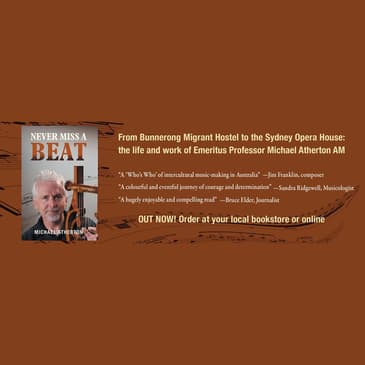
[00:00:52] and to welcome to our program our guest Michael Atherton, a truly remarkable and eminent Australian musician and educator. He is the founding professor of music at the University of Western Sydney where he retired recently and has been accorded the rank of emeritus professor and he's been given the award of the Order of Australia in recognition of his contributions over a lifetime to music and music education in Australia. In particular,
[00:01:19] he's characterised by an approach to music that emphasises its diversity, collaboration, innovation and its community base. Musician, multi-instrumental, composers, performer. He's an educator, a writer of books and an academic and he's particularly interested as I understand in cross-cultural music and across a lot of genres of music so it's a real delight to welcome you to Radio Northern Beaches Michael.
[00:01:47] Thank you. I'm just reeling at all that biography. You can all call me Mike. I'm just wondering how you got into music. Very complex, try to keep it short. Liverpool, Irish, Catholic, Welsh, Methodist background. I used to go to church with grandma on a Sunday while my father and my uncles slept off their hangovers in the Liverpool Terrace. I used to hear the Catholic Mass. I'd hear singing. Interesting.
[00:02:16] It had a lot of colour. Eventually ended up by default going to a Protestant grammar school because there was no Catholic one that I could go to. I didn't want to go anyway and I had to sing hymns every morning. So I was being, you know, osmotically introduced to the sounds of music and then my parents who weren't musical would buy records. In Liverpool it was Lonnie Donegan and of course we heard
[00:02:43] Frank Highfield, you know, we heard the Seekers. There was a lot of music records being played but for me the ultimate sort of nirvana or epiphany came when the Merseyside explosion happened and I was of course baptized an Everton supporter and I grew up with the Mersey Sound. So 1963 would love me to do
[00:03:08] was a very important part of my musical background and ultimately it was a song called The Last Time by the Rolling Stones which propelled me towards playing the guitar because I did quite well at school although I was told that I was tone deaf by the teacher. I wasn't interested in his teaching. He was a very stuffy old choir master. He used to tap out rhythms on these hundred year old desks and I just switched off. But anyway, I brought the guitar to Australia and that's the first riff I wanted to learn.
[00:03:38] So it's interesting that from that background of being a non-reading musician, self-taught and everything that I would end up becoming an academic. I had no idea but it was that music and wanting to learn this instrument that also helped me deal with living in a pretty ordinary migrant hostel for two and a half years. So I don't want to say I'm ungrateful but it was awful but it was music that gave me
[00:04:04] this inspiration. That's a long answer. That's a good answer. It's an interesting pathway, not least to hear that your teachers early on thought you were tone deaf because you are, I understand, a very talented multi-instrumentalist, albeit perhaps as you've said self-taught. I believe you pay a couple of dozen of instruments but I believe your fascination is with instruments in particular though and how they work and their sound. Is it as much as in if you like they're playing and what have you?
[00:04:34] Yeah, I think that came very early and it was a natural adjunct to, you know, when I did get into university but I used to always invent things as a kid. You know, I was the classic kid that would go along the palings with a stick in Liverpool and I'd bang on lamp posts and I'd listen to the letters coming through the door box and the coal, things I talk about in my autobiography. What I did with that guitar when I lived in a migrant hostel, a dear friend of mine, he had a tape recorder and we worked
[00:05:02] out how to cut a hole in the top and jam the tape recorder microphone into the body of the guitar, put the tape recorder on, turn it, the sound backwards and forwards and I had my first go of electronic music. And then we built a fuzz box and then I started making flutes and things. So, look, it's about exploration, isn't it? And it was probably something that eventually led me into music therapy.
[00:05:29] Anything can become a sound object and that was something I was very keen to tell my students at Western Sydney. I don't want to be stuffy. Yes, I adore and I give great praise on those musicians that play at the top of the classical tree. But there's other kinds of music and I wanted to make that part of the eclectic mix. I don't like stuffiness. I hate the division folk versus art
[00:05:53] music. I reckon it's absolute rubbish. And, you know, I can give you a very sophisticated argument. I'm not sure as in sound. But that to me is the great inspiration in music, something that you know a lot about.
[00:06:17] You know, the notion of being able to extemporise or improvise to bring music out of your soul and hear what you do. Your catalogue of music that you've both written, composed and performed and recorded over the years is so incredibly diverse and innovative and multicultural. Perhaps you might just take a listen to one of one of your pieces of music called Kite.
[00:06:39] This is very much my Celtic background coming through the Welsh and the Irish. It's a 6-8 tune, fascinated with guitars. The guitar on this track is Australian made. I'm playing a bass and I'm improvising mostly the most of the track with an overdub from guitars and then I put an Irish whistle on the top. There's a visual image of, you know, Australian bird life, which I adore. It's one of the
[00:07:08] great gifts, I think. And, you know, the whistling kite is an extraordinary creature as an image, but certainly drawing on a lot of what we call vernacular or folk music or music that's related to dance. If you had to characterise me, I'd say it's rhythm and melody that drive me along, not harmony. Mike, you're a music educator as much as a musician, a multi-instrumentalist and composer. What's your
[00:07:35] general approach and aspiration in introducing people to music and bringing them along in it? To instil in them the belief that they can appreciate, listen to and make any sound. The first thing I would say is that music is the art of listening. And when I set up the department at Western Sydney, I put a beautiful, huge photograph that I got framed of Miles Davis.
[00:08:04] And I put it high on the wall of the studio and he's looking down with his eyes shut and he's got his mouth over his lips as if to say, be quiet and listen. And to me, that's really important, learning to listen and appreciating being a listener, which means you don't always have to play it. You can hear it and enjoy it. That's what I tried to do. I didn't want to copy the conservatorium. I wanted to offer young people an opportunity to explore their musicality and their musicianship.
[00:08:34] Sure, they wanted to play Brahms or Schumann on the piano, they could, but I'd like them also to try and learn a jazz piece. Or if a drummer came along to join the course, I'd say, hey, there's a vibes and a marimba in the next room. Do you think you could perform on that for us in three months? I compounded this by, I let a couple of kids into the course who couldn't read music, but they were so passionate about it. So again, it was about connecting with people's soul. And that's
[00:09:03] why I hate the stuffiness, the division and the kind of the nonsense of, you know, the hoi polloi, that something must be better. Look, people do spend thousands and thousands of hours perfecting solo concerti and I admire that. That's great. I think you'll find a lot of those people respect the humble village musician in Bulgaria for what they can do too. And that's where I'm coming from. Is there a distinction and or a tension between music education in a university music faculty,
[00:09:32] traditional music faculty, maybe contrasted with say a conservatorium of music? Yeah, I think so. There is some permeability, but by definition, the conservatorium conservatorium or the conservatory is where one is preserving, conserving tradition of a high art approach. And that, of course, has been wonderfully subverted because eventually we got jazz taught
[00:09:59] at the conservatorium of Sydney, you know, where for a long time it was all, you can't do that. And I think you'll find that differs often from a typical university degree in music today where it's moving more into sound per se and visuals and sort of creative industry approaches necessarily connected to the changes in the music industry.
[00:10:24] But there's a place for both and there's a place for the crossover. But there always was a, you know, I mean, I copped a lot of flack when I started the department. There were people saying it wouldn't work. You know, you know, you can't be copying the conservatorium. Well, I wasn't. And I said, yes, it will work because it offers an alternative. If people want to spend three years, you know, with a teacher on one instrument in the conservatory, that's fantastic. But if others come along and say, do you know what? I want to be able to play a concert.
[00:10:53] Yes, I want to play some classical on my piano, but I want to know how to operate a sound desk. I want to know how to use a PC to write some music. That's what I was interested in, where we are today and what young people are doing. I have to say now, if someone offered me a job to set up a music department, I'd run 100 miles. I'd be too terrified because I couldn't guarantee them any kind of employment unless I came at it from a completely different approach. I think we're going back to a lot of self-teaching.
[00:11:23] I think universities are crumbling. And I think as AI takes hold, we're going to see an incredible interest in what I call humanly proud, people actually performing or doing something with their hands. I think only this week Swedish classrooms have said, we don't want laptops and screens during the day. We'll have pencil and paper. You know, you've got all your other devices in the evening. I think it's a very interesting time.
[00:11:49] I'm here in conversation on Radio Northern Beaches, Oz Music with Michael Atherton, a musician and music educator, Foundation Professor of Music, University of Western Sydney, Emeritus Professor these days. A particular strand in your music over time and your interest as an academic and I believe as a composer and performer is cross-cultural music in terms of the genres and style and traditions. And you've been involved in a lot of that.
[00:12:15] We might take a listen to a track of your song of Sekilos, is it? Which is an ancient Greek piece. Can you tell us about this piece and where, again, where this fits into the broader aspect of your interest in cross-cultural music? Well, this is about research and discovery and curiosity. This piece of music survives on a stone tablet, on a gravestone, going back to, you know, the year 300 in the common era.
[00:12:42] And Song of Sekilos is a song about carpe diem, you know, make haste, enjoy life while you can, you know, love and live because you ain't got long. I was kind of inspired in these pathways because living in Australia, you can't help but notice that you're part of an incredible conglomeration of people with cultures and things from around the world.
[00:13:06] So I met a lot of Greek musicians and I met a fantastic Greek violin maker, Harry Vituliotis, or Cypriot violin maker. He made an instrument for me to play in this music, just as I've met Turkish musicians who taught me the balama. The idea of crossing culture is not to ransack or to appropriate, but it's like a journey of discovery, understanding more about yourself because all these things are connected. So the Song of Sekilos is a good example.
[00:13:36] I mean, the singer is a beautifully voiced Sydney soprano. She's retired at the moment, unfortunately. Mina Kaneridis, she's a Greek-Australian who sang with the Brandenburgs and the Renaissance players that I was in. And so here she is singing in ancient Greek and I've got this little Greek instrument, the Pandurion.
[00:13:55] And it was part of a project I put together for the Australian Museum many years ago to explore ancient Greek music, which is, you know, like celebrating something that it's hard to know how to reconstruct it. But through that, you know, developing respect for those in Greece today that are researching that music, which is part of our heritage. You know, we have an incredible heritage of music in Australia from thousands and thousands of years ago to the recent colonisation and diasporas.
[00:14:26] And it would seem to be mad to shut that off. And I hear a lot of young kids kind of embracing that. I did the same with ancient Egyptian music. There's no notation for it, but I created a kind of a memorial, a creative realisation of what it might have sounded like based on sources. I went and spoke to scholars and learned how to pronounce ancient Egyptian language. And it's not going to go on the hit parade, but my music's never been about that.
[00:14:54] Mike, you were for a number of years a member of a group that basically pioneers and still does, does it, this approach to world music from about 1980 called Sirocco. It was a trio initially founded in 1979. I just finished playing for six years with the Renaissance players, which I enjoyed immensely. And I used to play with Wayne Richmond, who started Humph Hall, which you may well know about up your way.
[00:15:21] Sirocco came about as a trio and I joined and we became a quartet and I became a kind of a producer producing albums. The idea was to blend Celtic music with music from the Middle East sometimes, but particularly from the Balkans. It grew out of Bill O'Toole's skills at making instruments. And we were hearing around us, Greek, Turkish, then Yugoslavian. It's gone now musicians, but, you know, we had Latin American friends.
[00:15:51] So we would often jam and gig with these people as you do in jazz. And so there was a link in what we called the wild music of the villages of Europe, particularly, that drew us together and propelled that music in a sense cross-cultural. You know, sometimes we copped a bit of flack, people saying, oh, you're nicking other people's music. But that wasn't the spirit of it. It was trying to find different ways of expressing dance music in particular. I mean, if you dig deep into Irish music, you'll find so many other musics in there anyway.
[00:16:21] So it's hard to be proprietorial. But certainly it seemed an interest because Australian vernacular music had always been called folk music. And it was very much of the Anglo-Saxon hint of Anglo-Celtic tradition with the Varsovianas and the Xhottishas and the Polkas and men with beards and pipes reciting Henry Lawson. I don't mean to be unkind, but it was kind of hung onto as a stereotype for too long.
[00:16:48] And, you know, people forget that, you know, the Chinese were doing a lot of music in Bendigo in the alcohol rush and beyond. So we were suddenly pushed forward. And the background, like Bill, born in Australia, guy to Andrew with some Polish background, myself with Welsh Irish and a migrant. But we were playing music that wasn't necessarily from our birthright, if there is such a thing.
[00:17:13] And it was wonderful because we were employed a lot by music of Eva and put in front of classical music audiences. You know, we're typically going to hear string quartets and they loved us. They used to put us on at Mitagong. And I think what they heard was a connection between something that I was pushing, the links between medieval and early Renaissance music and its links through the Crusades to the Middle East and then into the kind of the dance forms that became the Baroque suites and beyond.
[00:17:43] And, you know, like the Celtic folks, where even today in an Irish session, you're playing a group of dance tunes. So it was a wonderful period in my life. It was hard to make a living out of it. And that's why my then wife said, mate, you better get a regular job. But anyway, that's another story. Our guest on Oz Music, Mike Atherton, who is, as we're hearing, a musician and composer and performer and listeners.
[00:18:06] You might like to get along to a presentation he's giving locally here in the Northern Sydney area for ABC Friends Group on Thursday, the 12th of March, I believe, at Roseville. 11.30, including a lunch. You can find out the details of this at the ABC Friends website for Northern Sydney. Mike, another aspect, a great interest in innovation as well as diversity. I believe that you're involved with another called Sync, which is more experimental.
[00:18:34] And is it electronic or what is it? Yeah, it was. It's been and gone. Worked with a really interesting music technologist, Garth Payne, and more recently with John Drummond. They're both academics in full-time positions now, but they're just computer geniuses, guru types. So I was just blending acoustic instruments with electronics that I would play. And they were using artificial intelligence before people started talking about it.
[00:19:01] But these machines would listen to you and play stuff back and you'd improvise with them. It's a bit different from just having a loop machine. But I found that really interesting because they themselves, who were more interested in computer music, were interested in it as well. So it's something I do from time to time. And that grew out of it. I spent quite a bit of time in the 80s and early 90s running music for film.
[00:19:24] I would use all kinds of synthesizers and found sound objects and wherever I could, wherever I needed it. That was always kept alive. But once I became a full-time academic in 1993, I had to forego a lot of things. Most of my touring, there was no time to do film composition. So I focused mostly on choral music. What sort of movies and TV shows were you writing music for? And from a musical point of view, what was it offering you as an opportunity besides, presumably, a chance to make some money?
[00:19:53] Yeah, it was always good to earn some money because I had a family. But I specialized in music for documentaries and feature documentaries. And I was very interested in films that had strong social history, social justice aspects. So I work with Alec Morgan, a wonderful filmmaker, on a film about a black death in custody. I worked with another director on Feral Horses in the Outback. And then a series on Indonesia, on the rise to power of Indonesia.
[00:20:22] And another film called Admission Impossible about the white Australia policy. So I was very interested in the text and wrote my music accordingly. I did a feature film called Dog Watch, sort of almost a Shakespearean film set on a drug boat. But I think something that film music offered was, at that time, was I was able to do a lot of music myself using multi-tracks. So I started with a, you know, in the late 70s, early 80s, with a four-track machine.
[00:20:52] I became an eight-track machine. And because I could overdub and I'd play, you know, the guitars and the basses and I'd play some woodwinds and then hire people to come in. So it was one of those things that kind of grew. And that's what a lot of film composers did. They'd work to a budget. You did what you could afford. But I think that we were better off then because the budgets were better. We could actually do more for less. These days, film directors and producers, you know, think you can just press a button and produce a whole score.
[00:21:22] And it's a shame because a lot of the people who developed, you know, pioneered really exciting film music in the 70s, 80s and 90s were top musicians. Sometimes jazz musicians, blues, classical, and they were very eclectic. And I think that's probably the word that's most important. Film music allows you necessarily to be eclectic because one minute you might have to write, you know, a bit of 12-bar blues for a pub scene with background piano.
[00:21:50] And then you've got some music where you've got to drive the action forward, you know, when something else is happening. So you've got background, foreground. So there's a kind of a theoretical element. But it is part of being collaborative. And I used to say to my students when I was teaching them, don't think that you can go into a film with the big idea. You'll have to be subservient. You usually come along at the end. The house has been painted, as it were, and you're providing an colour.
[00:22:18] So that for me was interesting because it drew my interest in writing, in character. And I would always say and I maintain to this day, film music is the invisible character in a film. Take it out and most films fall over. But most of the film is done when you get into it. So you've got to work with that. I would say that a lot of famous Australian card-carrying classical composers couldn't write a film if they tried.
[00:22:46] Because you've got to listen to film, watch it, immerse yourself into it, make mistakes and work with directors. So starting with documentaries, you do a lot of stuff in advance and cut to picture. Whereas when you get to a feature film, you're given virtually the final film. You've got to write, you know, between lines, over lines. So there's a mathematical element and it's quite stressful. The Aussie Music Radio Northern Beaches with our guest Mike Atherton.
[00:23:14] I guess you're as busy as ever, are you, in your retirement? I'm nowhere near as busy and I'm more a one-person band again. But I've been learning my ancestral Welsh language for two years. And I'm very delighted to say that this year again I've been selected to perform at the Australian Celtic Festival. And I'll be sort of playing Welsh and, you know, Britain. I'm interested in Britain. Repertoire is doing some songs in that.
[00:23:43] And I'm working on an idea that came from my book on the piano about the Changi piano, about the piano that helped men keep their lives together in Changi in the prison work. I'm not doing any teaching. I do a bit of mentoring and I've got six grandchildren that are quite bonding. And I have a 20-year-old son who has perfect pitch and is a fabulous fiddler. Both two things that I don't have. So that's good. We don't have to come to mind over that.
[00:24:11] Well, listeners, Radio Northern Beaches, you can catch up, I guess, with some of the performances and work of our guest Mike Atherton. I'm sure if you Google him and particularly, I guess, a website, Michael Atherton. Yeah, not the cricketer. I just write the musician. All right. People think I'm Michael Atherton, the cricket captain. I say no, I'm not. No confusion there and certainly not in the current situation. And listeners, you can catch him at a great presentation here on the Northern Sydney area,
[00:24:39] ABC Friends, Thursday, the 12th of March, 1130 through a lunch at Roseville. Do get long details on the ABC Friends website. And a couple of words, we go out on Shetland, recalling back into your Celtic roots, pretty obviously. Yeah, with Sirocco. Thank you very much indeed, Mike. It's been a pleasure listening to your music and reading about your life in music and particularly great listening to you and having the opportunity to talk with you. Thanks for joining us on Radio Northern Beaches. Thanks, Michael. Thank you for the opportunity.
[00:25:09] Australia, the lucky country. We've got meat pies. We've got the world's best beer. And most importantly, top of the list, we've got Radio Northern Beaches 88.7, 90.3. Now hitting the entire world on www.rnb.org.au.