
[00:00:00] You've tuned into Radio Northern Beaches. We live stream on rnb.org.au across the northern beaches of New South Wales, Australia, and all over the world. You can also catch us local on 88.7 and 90.3 FM. Our podcasts are available at your convenience at rnb.org.au or rnbpodcast.com.au.
[00:00:28] So you and your friends don't miss any episodes. Don't forget to follow and share. Now here's our latest podcast. Hello again, listeners from New South Wales, Northern Beaches 88.7 and 90.3 FM, streaming live at www.rnb.org.au. Programme's AusMusic and I'm Michael Lester. Michael Lester is a Yagel man from all the New South Wales, Clarence Rivers region, but he lives and works and performs as a musician here on the Northern Beaches,
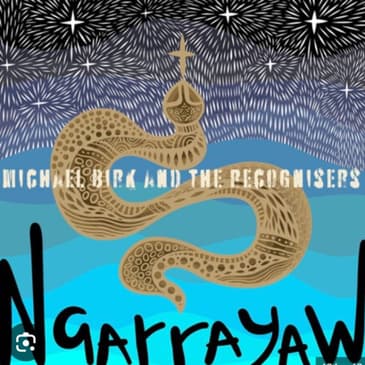
[00:00:56] where over the last 10 or 12 years too, he's founded and promoted a very successful community-based event, Singing Up Country, which is going to be on again this year, July 2026, up at Terry Hills. I was having a chat with Michael today about his newly released album, Naryal, but I'm sure I haven't got that right. So thanks for joining us again, Michael. Thank you, Michael. Yes. And the album has got an NG sound at the start, sort of like the end of song,
[00:01:24] but at the start of the thing, Naryal. So instead of an N sound, it's an NG sound. Naryal. Yeah, yeah. Naryal. And what's the significance of that particular word? I think it suited the name for the whole album. The word itself, Naryal, means the dreaming in Yagel culture.
[00:01:44] It's also another way to say the story of the river. It's a very encompassing word for a lot of my sort of worldview as an Aboriginal person from the Yagel country. Yeah, the dreaming and the river is just such big parts of our lives up there. Yeah. I think one of the lyric lines in that song, along the lines of, if I told you about the dreaming, I think, would you believe? So what's the message you're trying to get across there?
[00:02:12] Well, I've just made friends with a lot of people from all walks of life, different spiritualities and everything. And a lot of people seem to think that these stories were mythological, whereas I've been brought up to believe that, you know, that is the story of the landscape. But, you know, these things did happen. The spirituality is my identity, you know.
[00:02:36] Your language is obviously part not only of the culture you come from, but of your very identity and expression and development of identity, isn't it? Yeah. My journey with learning language, because, you know, I was not brought up with all of the language being spoken. Just little bits, fragments of the language that I grew up with. And then just more recently, the Yagel people have had a dictionary, Yager, Dulbay Dictionary, which is the Yagel language.
[00:03:06] Just reclaiming language and speaking it, revoicing it, it lifts your spirit. I suppose it's strengthened my culture going through this journey. Of course, your event that you founded now, heading for its 12th year up at the Terry Hills in the Northern Beaches, singing up country, it's very much a celebration of language and through that culture and relationship to country and caring for country and the identity of your people. Let's take a quick listen to your lead track, Nara You Are.
[00:03:35] Before we do that, what would you say about it from a musical point of view? I believe you've written all these tracks, including this one, I guess. And you're very much an acoustic guitar performer and vocalist, aren't you? Is that the sort of style, an acoustic style presentation? That's what I'm most comfortable with when I write songs. It always seems to be based around the acoustic guitar.
[00:04:00] I picked up the ukulele recently as well, so there's also some tracks with ukulele in it. You know, that acoustic sound, I believe that's where I'm comfortable, but also with our production, the whole production, we've tried to replicate this earthy sound that I've used in past recordings. This earthy mix, I suppose, it doesn't seem too commercially influenced.
[00:04:25] Yeah, well, we'll just take a listen to that title track here with Michael Lestere, his new album, Nara You Are. The title track here goes. Yeah, Michael, that's a splendid track. It does sort of, like a lot of your material, I think, starts off with you basically strumming away with your idea and your music. But they also tend to build up a bit, both with instrumentation and maybe intensity. And I think that one did a bit too, as you brought in other instruments. And he even brought in an electronic synthesizer in the background, didn't you?
[00:04:55] So you do work with a range of other instruments? Yeah, yeah. You know, we see what we can do in the studio, and then hopefully we can do a really good job with it live. Through this album, we got a grant from the New South Wales government and Sound New South Wales. So a very big thanks to them. And we also got some gear that goes along with the sounds that are in the album.
[00:05:20] It's been designed to go with this gear that we've got, like pedals, a voice pedal that also plugs the guitar into. Now's the journey to get the band together to try and replicate that sound. It's a tough road and always has been, and even particularly post-COVID for local musicians on the local music scene trying to make their way. How significant, you've mentioned this government grant, how significant over the course of your career, I guess,
[00:05:48] and you've been in music, I think, for at least 20 or more years, and your colleagues and collaborators, how significant is it to have available an access to government and public grants? Well, I feel very privileged to receive the grant, and it just made it happen really timely and professionally as well. We were able to have a very professional person do the mastering of the track as well, you know, for us to make it happen, you know,
[00:06:15] because we've got busy lives and we needed finances to make it happen in a timely manner. Yeah, it was released on Christmas Day, but we only started the recording on the 8th of November, so it was quite a quick turnaround to get it out there and put it out on the internet. So as well as I've got a lot of respect for the arts in general, and I love that the government puts money towards the arts,
[00:06:42] and I believe that's very much a thing that's needed in society. What do you think is the key challenge facing a musician like yourself, not least particularly from your own particular background and culture, in trying to develop your music and present it to audiences? Is it a challenge? Is it a sheer delight? Is it a difficult journey? I believe I can, you know, jump on the bandwagon with the networking that I've done.
[00:07:10] Like, people might be a little bit more active in the industry and you might be able to sort of jump on their wave and ride their wave. But I find, you know, I can only do what I can do myself and my band are not always gig ready. We have to prepare and, you know, for every time we do a gig, we've really got to put the effort in and get ready for those gigs.
[00:07:37] But with singing up country, that's given me a lot of momentum with getting my name out there and, you know, people seeking me, Michael Burke and the recognisers to come and perform. I think the greatest struggle for me is, yeah, getting the time with everyone together to commit to, say, if it's a gig or to go recording or something. It's just really hard to get together. Yeah.
[00:08:04] Yeah, I guess people caught up needing to live their own lives and earn their own livings and look after their own families. And so you do have this band, The Recognisers, and I believe that this album is presented as Michael Burke and The Recognisers. How long have you been working in a group format and has it always been The Recognisers as such? It's been about five years we've been jamming as a band and performing as The Recognisers. But before that, it was just myself, Michael Burke.
[00:08:34] But when I did form this band, I said to them that I like this name, The Recognisers, because when I was taught about the policy eras and stuff in my studies at TAFE doing Aboriginal studies, we had just come from the Reconciliation era. And right now, this is the Recognition era.
[00:09:01] So that was the inspiration that gave me the name. And everyone liked it. I can't think of a better name. I think it's a great name. Yeah, it's a nice name. I like it very much, particularly like your description of how you arrived at it and its significance in time and in the broader cultural context. I'm talking here with Michael Lestere on Aus Music Radio Northern Beaches. We're talking about Michael's new album, Gala Ya. Michael Burke and The Recognisers just out this Christmas.
[00:09:29] Let's take a listen to another track, Binnibur, I think. Biren Bay. Biren Bay is the name of the river, Clarence River, one of the names in the Yagel language. This one was a fun one that I had initially written in Sydney language from the Sydney language resource written by Jacqueline Troy. And it was back when I was working as a tour guide and it was for the kids
[00:09:55] and changed the words up this time for having Yagel language in it. It's pretty much very similar to the meanings of the words that I had initially. But it's a nice, fun one for the young ones to enjoy the album as well. I think it's got a fun, childlike feel to it. It's actually also got some very easy dance moves that not just the young ones like,
[00:10:21] but the elders enjoyed learning these dance moves as well when I presented the album to them at this language meeting that we had lately. I'll try and explain the me, me, me, me, papa, papa, me, me, me, papa, papa. That means mother, mother, father, father. And it's sort of like these dance moves go with the song with like a ririji. They're looking out over the river and it's flowing.
[00:10:50] And then Biren Bay, we're going for a swim in Biren Bay. It's just a fun one. I wasn't initially going to be on the album, but I pulled it out of my hat. And I'm very glad that I did because I love how the production turned out. And it's just a lot of fun. It just makes me smile. Got a lovely light touch, Biren, by that track that we've just heard of your album, Michael.
[00:11:17] Well, incidentally, listeners, I should perhaps enter an apology on behalf of both Michael and myself for the background noises which have been unavoidable. It seems that Michael's got some solar panel installation work going on behind there in the background with drills racing away. Got a campfire sing-along feel. It is a very lovely light feel about it. In terms of, you made some reference earlier to earthier production sounds, what is that sort of sound?
[00:11:46] And it may not necessarily be on that track, but maybe the next one we might listen to, Skies Are Blue. How do you go about, and what sort of sound are you trying to create? I think it's where it sits in my ears is it's got a moisture to the sound. I think in production we call these like the compression or something. It could be wet as well as the echo or reverb and everything like that.
[00:12:13] And I just like it to sound like it's fair dinkum, but it's not untouched or underworked. It's got the production value of radio playable music. To me, it seems like this is the way that this producer that I'm, I worked with him with my previous release, Wange, that I released in 2020. And I worked with him on this one as well. And he knows my sound.
[00:12:41] I don't know how to explain it myself, but I'm very happy to work with him again because he knows that sound that I want. And not even just like some of the other band members, they're also producers as well. So it was all hands on deck. And I'm just really lucky that I've got people working with me that have got such an acute ear for the sounds that we wanted. Yeah. It certainly is a wonderful sound. And I think for me anyway, it particularly comes through on your own voice
[00:13:11] and the way your voice is recorded and comes across, which captures much, I think, of what you've been saying. These sounds, and particularly in respect of your voice, which is, I think, a really unique sounding, rich, earthy voice. Is there any problem or challenge in trying to capture this during live performances? Yeah, I've got to warm up. I've got to look after my voice for, you know, days before performance. Is that right? In the future, I hope connect up with sort of a coach
[00:13:39] that can teach me how to look after my voice a bit better because, yeah, that's the thing. I was never formally trained or anything. I just sort of self-taught myself to sing. Now I'm thinking I should go to a vocal coach just to learn how to look after it. We might take a listen here with Michael Lester on his Music Radio, Northern Beaches, to another track of Michael's new album, Ngaraia, a track called Skies Are Blue. Yeah, Michael, that was Skies Are Blue. I mean, one of the things that particularly strikes me about that
[00:14:08] compared to some of the other tracks we're playing and on there, it's a very bright sound. It's got a terrific rhythmic feel and percussive feel about it, but I guess percussion is an important part perhaps of your sound anyway, dating back to your culture and cultural music perhaps. How would you characterise the sort of rhythmic and percussive elements of a song like Skies Are Blue?
[00:14:31] You know, I think I'm working with very good artists that are in my band. And the drummer, Patrick, he just works his magic. But yeah, that song, I just thought I wanted sort of different, sort of what I call chops to it. So it was in the middle there, there's a section that repeats
[00:14:57] that is sort of like a jazzy swung sort of way of playing and then it jumps back into this really rhythmic lower sounds on the guitar. And I liked that sort of contrast that was in these two parts and I thought that worked really well,
[00:15:20] as well as the production on it has some really cool sort of left and right, you know, the pans left and right and there's use of, you know, a thing over my voice which is sort of like a megaphone. Right. Yeah, and all of these things, yeah, as we said, we were designing these sounds so that they could be reproduced live.
[00:15:49] So, yeah, and that's my job is to, you know, navigate these pedal computer gear and stuff that I'll be using live. So I'm a bit daunted by that, but I'll get there as well as I know that with the songs it's not too hard to get there.
[00:16:14] So, you know, it was designed to make it easy for me to be able to do and replicate. As we're wrapping up here on Aus Music Radio Northern Beaches with Michael Burke and I'm relieved listeners to note that I think the drilling has stopped in the background for the moment. Maybe the solar panels are installed. Michael, I'd just like to hark back a little bit to your roots and origins. I'm wondering what your first memories are of musical performance that really sort of grabbed you and impressed you
[00:16:41] and that might have actually led you towards deciding you wanted to be a musician. I'm trying to think of this young fella's name. He was very young, back when I was even younger than he was, but he was a young person playing guitar. I can't remember his name, but he was this very young fella. He was on TV about his guitar.
[00:17:06] And I think when he was a little bit older and we had the Olympics here in Sydney at the Paralympic Games, he was part of the opening ceremony. I just don't know his name. But other than that, I remember going to gigs with mum and dad and family and I'll usually fall asleep. But I just remember that deep sound of the bass and the drums and stuff
[00:17:36] sort of whilst I was sleeping on probably my dad's chest or my mum's lap. Yeah. And yeah, I just remember like my dad, he loved John Williamson and we got to see him a few times and stuff in my memories. I also remember, yeah, just going to mainly like NAIDOC week stuff
[00:18:05] that was around the same time as my birthday. And yeah, I just remember, you know, just wanting to be a part of, you know, a band or something at an early age. I really liked that idea. And yeah, it just sort of came to be. Maybe that was an era of the black music movement, maybe too, that created an atmosphere for you.
[00:18:35] Yeah, yeah, yeah. I was always, you know, exposed to, you know, good music. We had this cassette tape, which was the sounds from Brand New Day before, you know, long, long before the movie. But way back when it was a play, Brand New Day, yeah, we had this cassette tape and that was, you know, the band Cuckles and Jimmy Cheese and, you know,
[00:19:05] just all this amazing stuff that, you know, I didn't know what I was, you know, listening to really until later in life when this Brand New Day movie came out. I was like, wow, this is a legendary story, you know. Okay, Michael, as we wrap up here with Michael Burke on Oz Music. Michael, where can listeners find your new album, Michael Burke and the Recognizers?
[00:19:32] I guess it's on most of the platforms and things and websites. What's the story there? Yeah, you know, I hope it's most of them. I'm, this is, you know, a new platform that I put it up through, so I don't know exactly what ones, but I know it's on Apple Music, Spotify and YouTube as well. So I think hopefully it's on all of them though. I don't know.
[00:20:04] Are you going to be involved in any process over the weeks and months ahead in doing live performances, either around the beaches in Sydney or more broadly? Promoting your music and getting your sounds out there and messages? Yeah, yeah. Once my band's all back in Sydney, people are overseas at the moment. So, yeah, I've got to get together first. We've got to practice and then hopefully a few gigs will come our way. We've actually also got a friend
[00:20:32] who is trying to help us get into the pubs because I don't, I haven't really, you know, hit up the pubs too much in the past. I've been more of a community event musician. But, yeah, I'd like to get into the pubs and expose my music to a broader crowd. Yeah, well, I hope you're successful in that because I'm sure people, not least among the Northern Beaches and in the pubs and venues around here,
[00:21:00] would take great pleasure and delight in the music as I have in checking out this new album of yours. So all the very best with that and thanks for joining us on Oz Music Radio Northern Beaches. Michael Lester with your band, The Recognizers, and your new album. All the best and talk to you again in the future. Cheers, mate. Australia, the lucky country. We've got meat pies. We've got the world's best beer. And most importantly, top of the list, we've got Radio Northern Beaches 88.7, 90.3.
[00:21:26] Now hitting the entire world on www.rmb.org.au.