
[00:00:00] You've tuned into Radio Northern Beaches. We live stream on rnb.org.au across the northern beaches of New South Wales, Australia and all over the world. You can also catch us local on 88.7 and 90.3 FM. Our podcasts are available at your convenience at rnb.org.au or rnbpodcast.com.au.
[00:00:28] Don't forget to check out our social media, Facebook and Instagram, which you can access from our website rnb.org.au. So you and your friends don't miss any episodes. Don't forget to follow and share. Now here's our latest podcast. All right, it's time for a Chrissy Mack's Rant and this one's going to be a bit of a doozy. So I want you all to stop listening to the politicians, all sides. Forget about all this fake blaming.
[00:00:57] And we're going to go through the actual facts of what's going on, how we got here and why today on the housing and other areas that I need. Have a spit the dummy over. So we're starting off today with looking at why finding an affordable roof over your head feels like a losing game of musical chairs. We hear about the housing shortage every single day.
[00:01:21] But who actually caused it? To find the answer, we have to look at a massive federal policy shift that took place between 2013 and 2022. During those years, the Liberal National Coalition fundamentally changed how Australia handled housing. They didn't issue a stop work order, but they effectively walked away from the business of building public housing directly.
[00:01:45] Instead of funding new bricks and mortar, they shifted the focus entirely to private and community sectors. They brought in a national housing and homeless agreement in 2018, which capped funding to the states and poured billions into rent assistance instead. Think of it this way. If you have a water shortage, you can either build a bigger dam or you can give everyone a slightly bigger cup to catch the rain.
[00:02:12] By subsidising private landlords instead of building government homes, we've been handing out cups for decades while the dam dried up. That is piece number one of the puzzle. So how is this fixed? A problem created by decades of government backing out of the market. The experts say it's not an either or situation. We need a dual track strategy. First, the government has to get back to building directly. Public housing acts as a safety floor for the entire economy.
[00:02:41] It's not there to make a profit. It's there to provide stability. But second, we have to reform the private market where most of us live. That means looking at the tax system, like negative gearing, and ensuring incentives are geared towards building new homes rather than just bidding up existing ones. It means fixing the seesaw so both public and private systems work together. So why do we have a shortage of hands needed to build housing?
[00:03:10] Try getting a sparky or a plumber out to Colorado Avalon right now. It's near impossible. How did a nation build on tradies? Run out of them. This is the history lesson that starts in the late 1980s and 90s. Back in the 60s and 70s, learning a trade was a highly respected, massively supported career path. Huge government departments like the old P&G, the railways, and the public works trained thousands of apprentices every single year. But then the policy shifted.
[00:03:38] The federal government pushed a new narrative. Every child must go to university. They starved TAFE for funding, closed down technical schools, and culturally downgraded the tool belt. We told a generation of kids that a lecture theatre was the only path to success. Now the chickens have come home to roost. Because we stopped training our own workforce, we've been forced to rely on skilled migration as a fast-track band-aid.
[00:04:06] Over 70% of Australia's permanent migration visas are now strictly reserved for skilled workers just to keep our construction sites moving. But here is the ultimate paradox. We need immigrants to build the houses, but those same workers need a roof over their heads the day they land. Relying solely on immigration to fix the trade shortage we created ourselves is putting even more pressure on an already bursting rental market.
[00:04:35] While skilled migration is keeping our construction sites afloat right now, the long-term solution has to start at home. We need a massive cultural U-turn. We have to properly fund TAFE again, fix apprentice wages so half of them don't drop out in their first two years, and show school leavers that a trade is a brilliant, lucrative career. Immigration is a temporary fix, but rebuilding our own hands-on skills is the real solution.
[00:05:03] Now, let's talk about the skyrocketing cost of building materials and why government projects always seem to cost double. Many of you listening will remember the 60s and 70s. Back then, we had actual rules on profit margins, especially in the retail and food sector. You couldn't just change whatever the market would bear. Mark-ups were heavily regulated, often capped at around 50%. There was a sense of a fair go margin.
[00:05:29] In 1973, the Whitlam government even set up a prices justification tribunal. If a major company wanted to raise its prices, they had to stand before a tribunal and prove the costs had gone up. But in 1981, the Fraser government abolished it, trading price control for free market competition. We lost the protection that kept corporate profit margins honest.
[00:05:57] And that brings me to the biggest policy shift of all. How our governments destroyed their own independent income. To fund shiny new projects, they decided to sell off the family silver. Let's look at who actually did this, because both sides of politics are responsible. Historically, the Labour Party's official platform included the democratic socialisation of industry, meaning they were supposed to be the champions of public ownership.
[00:06:24] Yet, it was Paul Keating's Labour that kicked off the biggest fire sale of public wealth in modern Australian history. They sold off the Commonwealth Bank and Qantas to get a quick cash splash. By the time the Liberals took over in the late 1990s and 2010s, the precedent had already been set. The Liberals simply scaled it up to a massive level by targeting the everyday utilities like power and water infrastructure.
[00:06:53] John Howard sold Telstra. And successively, state Liberal governments leased out our electricity poles and wires. So, if our listeners are looking for someone to blame for the lack of state income today, they have to point the finger to both sides of the aisle. They both took the cash splash when it suited their budgets. And now, because the government doesn't have these steady utility profits rolling in anymore,
[00:07:18] they have to rely entirely on taxing you and I to fund basic infrastructure. On top of losing our asset income, governments have created a monster called the Red Tape Premium. When a business quotes on the government job, like a block of public housing, they aren't just quoting for timber and nails. They are padding the prices to cover mountains of paperwork, safety audits and strict commercial specifications. So we're stuck. We killed off the price justification.
[00:07:48] We sold the utilities that used to make the state independent wealth. And we added layers of bureaucracy that make government building projects incredibly expensive. If you want absolute proof that free market competition isn't working to keep prices down, look no further than the landmark federal court decision against Coles. The court found that Coles systematically misled shoppers with their down-down promotion,
[00:08:15] spiking prices for a few weeks just to drop them back down and call it a saving. The judge exposed it as an illusion. This is exactly why we need a modern version of the 1970s Price Justification Tribunal. Instead of waiting years for the ACCC to take a supermarket giant to court after we've been ripped off, we need a system where big business have to prove their prices are fair before they hit the shelves.
[00:08:43] But this corporate entitlement goes way back beyond the grocery aisles. Look at our energy sector. We sold off our electricity networks, but now the New South Wales government is forced to underwrite the private airing power station until 2029 just to keep our lights on. We are caught in a ridiculous cycle. Privatise the profits, socialise the losses. When these big utilities make money, the corporate stakeholders get the dividends.
[00:09:09] But when they mismanage things or get heavily into debt, they hold a gun to the government's head because they are too big to fail. If we are using taxpayers' dollars to bail these companies out, why aren't we taking a piece of the company in return? In the US and Europe, governments often demand actual shares, equity, in exchange for a bailout. When the company recovers, those shares are sold back and the profit goes straight back to the public budget.
[00:09:39] Imagine if we did that here. Instead of just taxing your hard-earned income, the government could use corporate investment to build our roads, hospitals and social housing. Now, Treasury officials will tell you that taking over a failing company means inheriting its debts and liabilities. They say houndouts are cleaner. But as long as essential infrastructure like power, water and transport
[00:10:03] are treated as private cash cows, the taxpayer will always be held over a barrel. If public money is the safety net, then the public deserves a seat at the boardroom table and a cut of future profits. Well, listeners, I say it's time to bring the fair go back to the way our country is run. Now, over the period of this program, we'd covered a lot of ground,
[00:10:29] from the housing crisis to the tradie shortage to the loss of our price controls and public utilities. And as I've been sharing this with you, I sense some of you might be asking, well, who are you, Christine McCormack, to be telling us all this? Why should we take your word for it? It's a fair question and my answer to you is simple. I'm telling you all this because I've lived it. I grew up through these very decades. I started work when I was 16 years old at a retail store called Mayfair
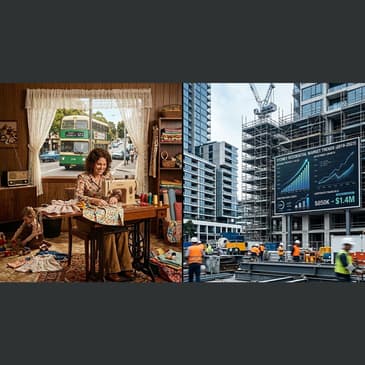
[00:10:56] and later went to work for Woolworths supermarkets, back when corporate spaces were run very differently to the way things are done now. When I became a mum, I was able to stay at home with my children most of the time because we actually had a thriving cottage industry back then. Mums could make an honest living from home crafting sheepskin boots for toddlers, knitting and sewing children's clothing or making peak hats. But over the years, successive governments changed the rules and got rid of all that.
[00:11:26] Later in life, I worked in strata management and right in the thick of the building trades. My dad was a bus driver right here on the northern beaches in the early days before he transitioned into working as a wall and floor toilet. In his later years, the trades run right through my family. My eldest son is both a fitter and turner and a plumber. And today, my grandson is working right alongside him as his apprentice. My youngest grandson, still at school, is considering becoming a carpenter, which I'm quite thrilled about.
[00:11:56] They're very hard to find. My youngest son preferred the office environment for a while, still doing some trades on the side, until he eventually moved down the coast where the only work available to him was as a removalist. So when I talk to you about the checkout counters, the loss of our local industries, the cost of the bricks or the struggles of apprentices, I'm not reading you textbooks or quoting you political press releases. I've lived the whole scenario right alongside you.
[00:12:26] On the northern beaches, we live in a beautiful part of the world. And understanding how we got here is the first step in looking after one another for the future. Australia, the lucky country. We've got meat pies. We've got the world's best beer. And most importantly, top of the list, we've got Radio Northern Beaches 88.7, 90.3. Now hitting the entire world on www.rnb.org.au.