
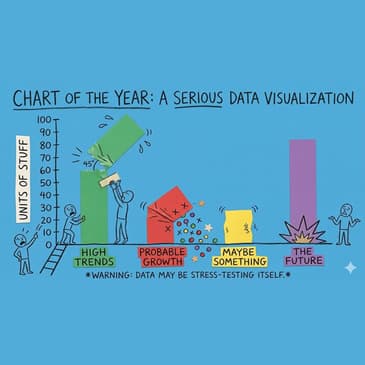
[00:00:00] Hi, I'm Chrissy Mack from Radio Northern Beaches and you've just tuned in to the Listen and Chat with Chrissy Mack Podcast. This is the space where we pull no punches, sometimes a little controversial, sometimes downright outrageous, and sometimes just packed full of information that is interesting to know. Have you ever heard the phrase numbers don't lie? It sounds right, doesn't it? We trust data, we trust charts.
[00:00:25] If someone shows us a graph with official looking bars on it and percentages, our brains automatically think, well, there it is, that's the truth. But here is the real truth. You can use 100% accurate factual data to tell a complete and utter lie. Today we're going to pull back the curtain on how information gets manipulated using an economic chart making the rounds right now.
[00:00:54] As our prime example, it looks completely convincing at first glance, but once you know what to look for, the illusion falls apart. Let's look at how data gets twisted. Imagine a bar graph titled Per Capita Economic Growth by Federal Government. You look at the screen and you see massive towering bars for the Hawke-Keating era and the Howard era, both charting way up past the 30% growth.
[00:01:24] Then you look over at the very end of the chart at the current Albanese government, and the bar is a tiny silver, flat and red sitting down below zero. Well, the immediate gut reaction conclusion the creator wants you to make is, wow, the past leaders were economic geniuses, and the current lot are driving us straight into the ground. The data point themselves? True. They came straight from the official Bureau of Statistic Reports.
[00:01:54] But the conclusion? Completely manufactured. Here is how they did it. To spot the manipulation, you have to look at what the graph isn't telling you. It commits two massive sins of data distortion. Let's take a look at the time frame trap. Comparing apples to watermelons. The biggest trick in this graph is that it uses culminative growth instead of annual average. The Hawke-Keating government was in power for 13 years.
[00:02:22] The Howard government was in power for 11 years. Current government has been in office for roughly 4 years. Comparing the total accumulated economic growth of over a decade to the growth of just 4 years is completely ridiculous. It's like comparing the life savings of a 60-year-old to the savings of a 22-year-old, who had just started work and concluded that the 22-year-old is a financial failure.
[00:02:51] Of course, a bar representing 13 years is going to be a great deal taller. It had over three times longer to stack up. If you want an honest comparison, you look at the yearly average rate. But doing that wouldn't give the graph designer the scary red bar they wanted. Then let's look at stripping away the global content. Data doesn't happen in a vacuum.
[00:03:14] To look at the country's economic performance without looking at what is happening to the rest of the world is intentionally misleading. The last four years haven't been normal economic times. Australia and the rest of the world has been digging itself out of a massive economic crater left by the COVID-19 pandemic.
[00:03:37] The unprecedented billions printed and spent during the pandemic lit a fuse on global inflation. To combat that inflation, central banks worldwide raised interest rates rapidly, internationally slowing down economies. Add in the major international conflicts, global supply chain shocks and energy crisis, and you have a global economic headwind.
[00:04:03] By ignoring the global context, the creator of the chart tries to blame a worldwide post-pandemic hangover entirely on domestic politics. The takeaway from this, the lesson learned. Factual manipulation doesn't happen by making out numbers. It happens through a mission. It happens by removing context, distorting timeframes, and shifting the goalpost until the truth says exactly what the creator wants it to say.
[00:04:32] The next time someone hands you a chart that perfectly triggers your anger, or matches the political narrative, don't just look at the height of the bars. Ask yourself, are the timeframes fair? Is the context missing? What are they trying to make you feel right now? Be sceptical of data, because the facts can be weaponised just as easily as rumours.
[00:04:57] Well, I'm Chrissy Mack, and as usual, that's my opinion, and not necessarily anybody else's. Alright, I hope I've given you a lot to think about, and talk about, and debate, and maybe disagree with. Don't forget to follow, like, and share. Stay safe, and I'll catch you next time.