
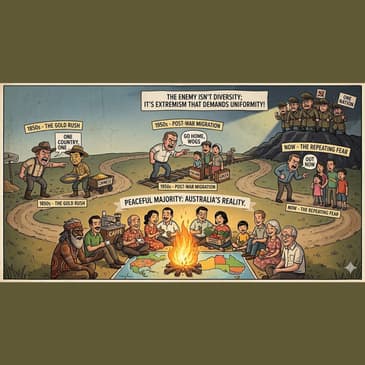
[00:00:00] Hi, I'm Chrissy Mack from Radio Northern Beaches and you've just tuned in to the Listen and Chat with Chrissy Mack Podcast. This is the space where we pull no punches, sometimes a little controversial, sometimes downright outrageous and sometimes just packed full of information that is interesting to know. Well, I was going to leave politics alone this week but then Pauline Hanson had her speech.
[00:00:25] So, today we're taking a scalpel to a word that gets thrown around a lot by modern commentators and populist politicians, monoculturism. It's the ideology that a nation is only safe and stable if it enforces one culture, one religion and one single belief system. On the surface, the people pushing this claim it's about patriotism and unity.
[00:00:53] But when you look at the reality of human nature, and specifically the reality of Australia, the idea of pure monoculture completely unravels. To start with, you cannot look at Australia's history and claim this was ever a monocultural continent. Long before European ships ever arrived on their shores, this land was home to hundreds of distinct indigenous nations.
[00:01:22] The first peoples of Australia were not one single group. They represented vast diversity, hundreds of different languages, unique law structures, distinct boundaries and deeply diverse spiritual beliefs. Even when you look at our past colonial history, the myth of a unified, single culture falls completely flat.
[00:01:45] Every generation of Australians has picked a new target to treat with suspicion, using the exact same fear-mongering we're hearing today. Looking back at the 1850s and 1880s, during the gold rushes, it was the Chinese who were targeted, rioted against and told they could never be truly Australian. But they stayed, worked the land and became a bedrock part of our communities.
[00:02:12] Then came the post-war migration boom of the 1950s and 1970s. Suddenly, it was the Italians and the Greeks who were being given a brutal time. They were called wogs, mocked for their language, and treated as outsiders who were going to ruin our culture. Today, their kids are our cultural icons, and their food and coffee are what we call modern Australian lifestyle.
[00:02:39] And even before them, the early convicts and European arrivals themselves weren't one happy family. They were English, Irish, Scottish and Welsh, fractured by centuries-old religious warfare between Catholics and Protestants. They literally rioted in the streets of early Sydney because they couldn't tolerate each other's beliefs. From day dot, diversity was baked into the fabric of this country.
[00:03:07] There was never a one-size-fits-all foundation. Because at the end of the day, it isn't race, colour or creed that threatens our peace. The vast majority of people from every imaginable background want the exact same things. To work hard, to protect their families and to live in harmony. The real enemy of peaceful society is extremism.
[00:03:33] It is that intolerant, fanatical mindset which can pop up in any group, religion or political ideology that says, My way is the only way and I have the right to demonise or destroy anyone who disagrees. It's the behaviour of the extremist fringes we have a problem with, not the diversity of a peaceful majority. And that brings us to the ultimate glaring contradiction in our modern political landscape.
[00:04:03] We have right-wing nationalist political parties today, like Pauline Hanson's One Nation, who scream the loudest for a monoculture. They tell us that if we just had one culture, we would all finally be united and on the same page. But think about the logic. If a true monoculture actually worked, if putting people of the same general background together meant everyone instantly agreed on everything,
[00:04:30] then a party like One Nation wouldn't even have a reason to exist. If we were all naturally on the same page, our politics would be completely silent. There would be no division to exploit and nothing left to argue about. The very politicians who claim a monoculture will bring us unity are the exact same ones making a living by keeping us divided.
[00:04:54] People who advocate for a pure monoculture often say they want to protect freedom and Western values. But let's look at the historical reality. While monoculturism and communism are technically two different things, in practice, they end up looking exactly the same. When communist regimes have taken power historically, they have almost always tried to enforce a strict, top-down monoculture.
[00:05:24] In pure communist theory, everything is about social class. To make everyone equal, these regimes systematically erased individual ethnic identity, local traditions, and especially religion. They demanded one unified, standardized citizen who served the state. Just like forcing a country to be monocultural requires immense government control,
[00:05:52] and stripping away personal freedom, communism requires the exact same thing to force economic and social conformity. When it comes to the methods, the total state control and absolute intolerance of difference, and the forcing of people into one identical box. Monoculturalism behaves exactly like a totarian communist state. They only differ in their starting motivations.
[00:06:20] Communism is an economic and political system designed to eliminate private property and force conformity on how you work, what you own, and what you politically believe. Monoculturalism is a cultural framework designed to protect a single heritage, forcing conformity on how you speak, your ethnicity, and your faith.
[00:06:45] What this means is that forced conformity isn't exclusive to one side of politics. You can have right-wing monoculturalism, extreme nationalist regimes and dictatorships that hate communism, but still demand everyone look and act the same. And you can have left-wing monoculturalism, like Soviet communism, which wiped out local cultures to create a single state identity. The playbook is identical.
[00:07:14] If you try to enforce a monoculture on a free, diverse country like Australia, you have to throw away Western freedoms. You have to use a big government control, strip away personal choices, ban religious freedoms, and force everyone to conform to one state-approved identity. The monoculturists run straight into its arms. Well, there you have it. Monoculturalism.
[00:07:42] Australia is a wonderful place to live. We have the most amazing country. We have the most amazing mix of cultures. An extremist is the enemy in every different form, not our majority culture. This is Chrissy Mack. These are my opinions and not necessarily anyone else's. Thank you for listening. All right. I hope I've given you a lot to think about and talk about and debate and maybe disagree with.
[00:08:12] Don't forget to follow, like, and share. Stay safe. And I'll catch you next time.