
[00:00:00] Hi, I'm Chrissy Mack from Radio Northern Beaches and you've just tuned in to the Listen and Chat with Chrissy Mack podcast. This is the space where we pull no punches, sometimes a little controversial, sometimes downright outrageous and sometimes just packed full of information that is interesting to know. Listeners, today I have in the studio with me Matt Adderton from MWP Community Care. Welcome, Matt. Thanks for having me.
[00:00:25] We're going to talk a little bit to you about MWP Community Care. Tell us what MWP stands for. MWP stands for Manly Warringah Pitwater Community Care. And what do Manly Warringah Pitwater Community Care do? Well, Manly Warringah Pitwater Community Care has been around for around about 60 years. Next year, 60 years. So we will have obviously some celebrations next year, but we're a Commonwealth Home Support Program provider. So that's funded by the Commonwealth Government.
[00:00:53] So we provide support to the elderly people across the Northern Beaches. So I suppose our main goal is to help older people remain independent, connected and living at home for as long as possible. We're a volunteer led organisation as well. We have about 110 volunteers that do a lot of our driving and taking people to various appointments. We take them to shopping. We take them on group outings. We also have transport where we take them to hospital appointments. So it's a one-on-one service. So we pick up our elderly person and we take our clients.
[00:01:23] We take them to the shops, do the shopping with them, bring them back. So we have a number of services. The five main key areas that we do is what we call social support individual. So taking people shopping and taking them to appointments. Social support group. We do group outings. So every month we do about 10 outings. We have two buses and we take them anywhere from local DY RSL for lunch through to the postman boat tour up the Hawkesbury. We take them into the Archibald Prize.
[00:01:52] We take them into a number of different venues. Whatever's going on, we've seen that in. We did Vivid this year as well. We did a night trip through to Vivid as well. The other area we do is transport, which is directly to hospital and back from that point of view. We have a called group so that we have the Filipino group. We have Italian, Chinese and Serbian groups that we also have and hold lunches for. We take them on outings. So it's multicultural. Very multicultural. So we've got multicultural groups as well as I suppose everything else that we do.
[00:02:20] So in regards to the social support and the group activities, we also do exercises five days a week. So that includes chair yoga. We do move and groove, dancing. Oh, I'd like that. Yeah, which is great. And we also do exercise as well. We have Vivian is our trainer. She comes in five days a week, which is fantastic. We have a program called Silver Surfers. So Silver Surfers started about two years ago now. And what is Silver Surfers? Well, Silver Surfers is in conjunction with Manly Surf School.
[00:02:48] So what we wanted to do is on the beaches, we wanted to get people, elderly people and our clients back into the water. So we're running a program with them that we turn up to Manly and get water every or Palm Beach every two weeks. So the program runs that we have them turn up. We give instructions on how to actually use a bodyboard, boogie boarding. We take them out in the water with instructors and we get them out boogie boarding. And they love it.
[00:03:10] It sounds like a hell of a lot of fun, especially for people who have been around the house a lot and don't get out and possibly have little or no family around them. That sounds like a brilliant system to work with. Well, a lot of all that comes out of these things and you think it's just an event. But the biggest thing, I suppose, for when it comes to, you know, I suppose an elderly clientele is that once you lose the car, you lose connection. Yeah, definitely. I'd be lost without my car. I go everywhere, do everything. I'm so active.
[00:03:37] To lose a car for me and probably for those people you're talking about would be devastating. It is devastating. You can't just pop to the shop. You can't pop around to see your friend anymore. You can't go and see your daughter or your son or your grandkids. You can't do that just automatically anymore. You need you rely on people. So silver surfers and I suppose the whole essence behind most of the things we do is that it gives people the confidence. It introduces them to a new community and new people that they can connect with.
[00:04:05] So with silver surfers, a lot of people say we looked at the water. We used to swim all the time. We used to be part of the ocean swimming. We used to go in, you know, body surfing all the time. Some would surf. Now all of a sudden they lose confidence. They don't have the confidence to get back in the water. So with MWP and Manly Surf School, we sit on the beach. We teach them what to do. Then we're in the water with them and we're helping them get on waves. We're teaching them where to look for the, where to be in the surf, where the rips are. We also have involved in that is surface for climate.
[00:04:35] So we're also teaching them about ensuring the water's clean, why it's vital our ocean stays clean and the beaches. So it's a great program. So there's always, I suppose, something behind the programs that we do. Same with exercise. I went up there the other day and we were, you know, having a chat to the exercise group. And one of the ladies goes, look what I can do now. And she could actually get out of the chair without using her hands. Oh, wow. Before that, I could not get out of the chair. Well, that's a big achievement. It is a big achievement. And a lot of those things are when you're at home by yourself, you need to be able to get out of the chair.
[00:05:04] You need to be able to reach up and grab something from the cupboard where a lot of these people couldn't do that. But now with the help of the exercise and the ongoing program that's run, they're being able to do those sort of things. So there's a lot of those programs. I suppose the other two programs that we run or the other two areas that we're involved in is home maintenance. One of the biggest reasons people go into residential aged care is they can't look after their homes anymore. Yeah, I can relate to that. My son now actually lives with me in my house. And I've got quite a big house. We've organized it so his family could move in.
[00:05:33] And at the moment, because I used to do everything, and I'm still sometimes up letters. And if he catches me, I'm in big trouble. But yeah, he's doing a lot more of that because I was getting to the stage where I couldn't get up letters. I couldn't fix things around the house. And he's been really helpful. So not to have somebody there to do that, it does run down very quickly. It's surprising how quickly. And it's a bit of a mental health thing as well because people love their homes. They've grown up in their homes. They've raised families in their homes. They've had partners in their homes. And sometimes they pass away, sadly.
[00:06:03] But they want to remain because that's where their memories are. Yeah, definitely. And it's a pride. So when you walk out the front and the lawn's really long or the gutters are overflowing or whatever it may be, then it feels a sense of, I suppose, that the pride is not there. So that's why we do lawn mowing. We do gutter cleaning. We do small maintenance jobs, leaking windowsills. I'll need a roll that's put back on the door so they can use it properly. So we've got a maintenance side that we do as well. And is that at a cost? So there's a couple of ways to do that.
[00:06:31] But we're funded by the Commonwealth Home Support Program. So I suppose there's three main areas for aged care that you look at. And there is residential aged care, which has nationally about 250,000, 260,000 people in residential aged care. It's the most costly form of aged care. Then you have supported home, which used to be called the Home Care Package Program. I remember that, yeah. So people would get assessed and they'd get a level of package that they could use through the year.
[00:06:56] The third one, and they've got about 250,000 people on supported home programs. And there's about 120,000 to 150,000 people waiting to be assessed to get on that program. Are we talking about a specific area like New South Wales or is that Australia-wide? This is a national program that I'm talking about right now. Then when it comes to the Commonwealth Home Support Program, which is what we're funded for, there's about 830,000 people nationally that are on that program. So it's quite large.
[00:07:22] So the Commonwealth Home Support Program is seen probably as an entry level to aged care. So things that people can do some things by themselves, but they just need a little bit of assistance from that point of view. So there's a range of things. And like I said, the gardening is one thing where they just would love to be able to mow a lawn, but they can't anymore. They'd love to get on a ladder, which, you know, we don't recommend. But they can't do that anymore, if you know what I mean. So we go and fix those things. The other area, which is quite a big area for us, is home modifications.
[00:07:50] So I suppose one of the big things with home modifications is that fall in the home is the leading cause of hospitalised injuries and deaths among Australians, making it about 70% of all injuries hospitalised come through from falls, trips and hazards. So we'll put grab rails in. We'll put ramps where you can't get upstairs anymore. People still want to get up the stairs to the back to use their clothesline or to sit up on a chair up the back.
[00:08:19] So we'll put rails up their stairs so they can hang on to things. We do a lot of those smaller sort of home modifications, but we also do do full modifications. So if someone has a fall, goes to hospital and comes back and they can no longer get into their bathroom or they're in a wheelchair or they need a carer, we'll renovate the whole bathroom. So it's a, I suppose, a friendly, accessible bathroom with no hob around the shower. They need to step over or the bath has a cutout in it, which we call from tubway.
[00:08:48] We put a cut in it. We get rid of the glass in there as well, because if they fall and they shatter the glass, we put weighted curtains in there. So there's a range of things that we do. And we work very closely with a lot of occupational therapists or OTs, occupational therapists. And that's from Mona Vale, Royal North Shore, Ryde Hospital up to Hornsby. We do a lot of those sort of services as well. So they will go and do an assessment. They will look at somebody's home and say, yes, you need a ramp here to get inside.
[00:09:16] You need, you know, in the kitchen, you need some help there as well. You need a grab rail here. And then we'll provide an OT report. And then our carpenters and our builders will go out and do the renovations for them. Well, we didn't get to the cost side of it. So you're backed by the government in some instances, obviously you've got some support there. But what cost does it end up, or is there any cost to the customer? So there is a cost. We always recommend that before people need it, we recommend that you go and get registered with your MyAgeCare number, firstly.
[00:09:43] Then once you get registered with your MyAgeCare number, you'll get an assessment from an assessor who will come out and see you and say, what do you need? Yes, I need transport. Yes, I need modifications. Yes, I need this. So then what they'll do is I'll allocate you a referral code for the different services that you need. Then from that point of view, you will then come to MWP and we will then subsidize, thanks to the government, we will then subsidize the service that we provide for you. There's always a client contribution because that's mandated by the government.
[00:10:13] It'll be a small, but it'll be a small client contribution. So for exercise class, it might be a $20 or a $15 class fee. So we give you the exercise, we can pick people up and bring them to exercise. We put a morning tea on afterwards where they all sit around and have a good chat. Nice. And then we'll drive them home again. There's a slight one, but what we do is we'll subsidize that cost. And that's the same for maintenance and the same for modifications, group outings and all those sort of things as well. So there is a subsidy. Let's go back to the beginning. Register with them.
[00:10:43] What, how, why? Everybody that wants a service or needs a service or will maybe require a service down the track needs to go to MyAgeCare and have a MyAgeCare number. Okay. So how do they do that? Okay. So you go to the myagecare.gov.au website and there's four easy steps for you to follow. So you basically register with MyAgeCare or you can call them on 1-800-200-422. Then what you do is you complete an assessment. So an assessor will come and visit you in your home.
[00:11:13] They'll look around your home to go, yes, you've got too many stairs in here or yes, that's not good, whatever it might be. Or yes, you need meal support so we can organize them for a meal support for you. We can organize showering. We can organize those sort of things. Now we don't necessarily MWP do all of those things, but there are people that will help out do those things. Then what they do is they'll assess you. Then they'll give you referral codes for maintenance, modifications, group outings.
[00:11:38] Then you call the local provider and say, hey, I want to go on a group outing. Here's my referral code. We onboard you to the system. And away you go. You can utilize any service you want to do. But having a MyAgeCare number, a lot of people will hear, I don't need it. I don't need it yet. I'll get it when I need it. It takes time to get it. So I was just going to ask you, what's the criteria or where should we all be looking at? Because I'm 71.
[00:12:05] Where and how and why under what circumstances should we be looking at doing that? I would say any time from over 65, you should be looking at registering with MyAgeCare. Now, I registered my mum with MyAgeCare before she actually needed services because I knew that the process of once you've registered and you've got some referral codes, they don't expire. So you're in the system. So when you need them, you can call and get them. But as I say, the worst time to buy insurance is after you've been robbed. Yeah.
[00:12:35] So the worst time to try and get MyAgeCare and get referral codes is actually once you have a fall or once you actually need services because it takes time to do it. So I would recommend that get it done as early as possible because once you've got it, you've got it for life. You don't need to worry about it. It doesn't expire. You can keep it. And then when you need it, you've done everything you need to do. You can just start getting services from the various providers. And so does that have any repercussions for any other services such as Medicare, any of those sorts of things? So it's not means tested.
[00:13:04] It has no other implications with any other service. That's good to know. Yeah. I would recommend that you actually, like I said, that anyone over 65 registered, register even if you don't think you need it because all of us are going to get older and all of us are going to need a service at some point. You might drive until you're, like my dad does, he's 89 and he's still driving and still gets past the test. But he needs services in that area. So not everyone's the same. So I would recommend that get the service and then find out what you need and then you can go after that.
[00:13:33] And if you're not ready for it, you're still registered because it's there for you once you've... Yes, because you have to have a My Aged Care number to do any of those things. Okay. All right. That was really interesting because I didn't know any of that and I'm sure my listeners didn't, most of them, had no idea. Yeah. So that was very informative. Thank you very much, Matt, for that. Tell me about the fundraiser. So as part of our, I suppose, exercise and I suppose what we find is that mobility is a big thing in regards to aged care.
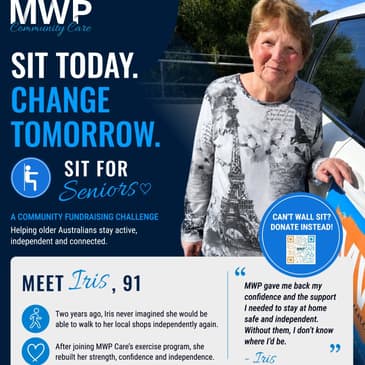
[00:14:00] So ensuring that you can, like I said, get out of the chair easily. You can reach up to your cupboard and get things out of the cupboards or you can, I suppose, pick things up from off the coffee table and those sort of things. So as you get older, obviously you get less and less potential mobility due to a fall or due to just old age. We're running a program called Sit for Seniors because we've got a, I suppose, our star of the show is Iris. And Iris is 91. And before she came to exercise, she was not able to get out of the chair.
[00:14:30] She couldn't use her hands to get out of the chair. She couldn't get up. So now she's at the point she can get out of the chair, no problem whatsoever. What we're trying to draw attention to with Sit for Seniors, so it's sit today, change tomorrow, ultimately is to encourage everybody to, I suppose, register, be part of it. Raise funds so we can improve the services that we provide and buy more equipment and get more involved. But the idea behind it is to just create awareness around that you need to keep moving. And part of that is whether you're exercising, whether you're walking.
[00:15:00] And it not only brings you a fitness when it comes to, I suppose, some strength and core, but I can tell you mentally the difference being coming to exercise and being able to do a wall sit or being able to get out of the chair, no problem. It might seem so small for some people, but I can tell you it's actually a big feat for some people. So that's what it's all about is to just promote healthy aging and healthy living, no matter how old you are. Okay. So tell us how do we find out about this? Where do we go website-wise or otherwise?
[00:15:30] And exactly what do you need to do to participate? So there's a couple of ways of doing it. So firstly, I would recommend going to our website, which is mwpcare.com.au. The first picture you'll see is our Sit for Seniors advertising. If you click on that, it will take you through to the page that talks all about Sit for Seniors and what we're raising money for. Two ways of being part of it. You can either register and through the month of September, do a wall sit for 120 seconds a day, or two minutes a day.
[00:15:59] If you can't do that or you're not able to do that, then you can also just donate to the cause as well from that point of view. So that's the information that is on the website. Other information on the website is our calendars, is our social support, is our maintenance, is our modifications. You can review and look at all of those and read all about that information. There'll even be information on how to get your MyAgeCare number.
[00:16:22] You can then also call us if you want help in regards to getting a MyAgeCare number and talk to Linda at MWP and can give her a call on 991-33244. And we can help talk people through the process. We can't get it for you, but we can help talk you through. Or we can help talk through your son, your daughter, or your support person that you've got. We can help work with them as well to get you or get whoever needs that number, the MyAgeCare numbers.
[00:16:50] And we can talk you through the events and the things that are on offer that we can help provide for you. So going back to the fundraiser, I'm not quite clear at how you raise money. You sit. Do you have people sponsor you for that sitting? Correct. Correct. Sorry, it's the same. So yes, you log on, you will either register, and then you put it out to your network. So I know I've got all my soccer mates are all sponsoring me to sit for seniors in September.
[00:17:14] So I put it out to them, and they donate $50, $20, $100, whatever it might be, to my cause. So I'm raising as much as I can. I'm going with my targets $500 to raise for that. So we have about 15 to 20 registered people at the moment. Our goal is to get about 30 people. And we've got a number of our providers also sponsoring us as well, which is great. But the way that you can be part of that is either you register and go and get people to sponsor you to do it,
[00:17:43] or you can just sponsor people that are already doing it as well. You can just donate to the cause. Okay. So your target was to get 30 people to do it to raise funds for you. That's correct. Yes. Okay, listeners. Here's your challenge. I believe you can do better than 30 people. So listeners, Matt, give me that address again. So go to mwpcare.com.au and click on the Sit for Seniors banner, which is the first one you'll see.
[00:18:10] So as you've been hearing, this is a really important thing, and they are an incredibly good service, which most of you, as I, have not really heard about yet. So let's get onto that website, and let's get the more than 30 people raising funds for them. That would be amazing. Forward, thank you in advance to everybody that jumps on board. Appreciate it. Look, it's been wonderful talking to you, Matt. It's been very eye-opening because, as I said, I didn't know of you. I didn't know what you were doing. And being in that age group, very interested.
[00:18:40] And for those people who are getting to that stage where they need help, I hope this has helped them a lot. Thank you for your time. And, yeah, we'd love to hear from anybody, and whether it be your audience or whether it be that they might know somebody that's interested, then by all means get in contact with us. Thanks for coming in, Matt. Lovely to have you. Thanks very much, Chrissie. This September, join MWP for the Sit for Seniors Challenge, a community fundraising challenge that helped more Australians stay active, independent, and connected.
[00:19:08] MWP Community Care gave me back my confidence and the support I needed to stay at home safe and independent. Without Matt and his team, I don't know where I'd be. Join MWP Care this September for Sit for Seniors Community Fundraising Challenge and help more older Australians stay active, independent, and connected. Visit MWPCare.com.au to join. Want to make a difference to your local community? MWP Community Care helps older people across the Northern Beaches stay independent, connected, and living safely at home.
[00:19:37] And we need volunteers like you. Whether it's driving someone to an appointment, helping on a social outing, or simply sharing time and conversation, just a few hours can make a big difference. Give a little time, make a big difference. Volunteer with MWP Community Care today. Visit MWPCare.com.au or call 9913-3244. All right. I hope I've given you a lot to think about and talk about and debate and maybe disagree with. Don't forget to follow, like, and share.
[00:20:06] Stay safe, and I'll catch you next time.