
[00:00:00] Hi, I'm Chrissy Mack from Radio Northern Beaches and you've just tuned in to the Listen and Chat with Chrissy Mack Podcast. This is the space where we pull no punches, sometimes a little controversial, sometimes downright outrageous and sometimes just packed full of information that is interesting to know. Today my friend and fellow producer Michael Lester is talking to Elizabeth Finkel about her book, Prove It.
[00:00:26] Welcome again listeners to Community Radio Northern Beaches 88.7 and 90.3 FM streaming live on our website www.rnb.org.au Programs Innovation Talk, I'm Michael Lester and if you enjoy these in-depth conversations, perhaps we might call them with expert people who know what they're talking about and about important things. You can find a whole archive of these that I've done if you Google me Michael Lester on Mixcloud.
[00:00:53] I've got dozens if not hundreds of these conversations which you might enjoy. By way of introducing our topic today, one might observe that since Donald Trump took office first time around, we've seen the emergence of what now has been styled as the post-truth era, in which there was a basic attack on the whole notion of idea and its integrity and accountability. And on the other hand, now with Trump 2.0, this has morphed, as we all know, into an attack on science, not just on truth.
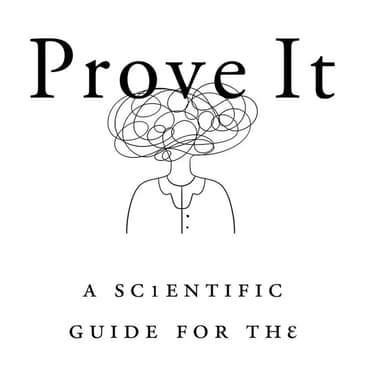
[00:01:20] Of course, there's a strong relationship between science and truth, as we'll discuss today. One wonders what one can do to try to live in a post-truth world and make any sense of it. I'm delighted to welcome to our program Elizabeth Finkel. Elizabeth has penned a book called Prove It, subtitled A Scientific Guide for the Post-Truth Era. It's published by La Trobe University and Black Ink 2025.
[00:01:45] Elizabeth started, if I understand, as a research scientist in biochemistry in which she worked. And she's pursued her life in science beyond that, becoming a writer, journalist, author and editor. For example, being the founding editor of Australia's maybe principal scientific journal, Cosmos, which unfortunately, I think might now have been shut down. Thank you very much, Elizabeth, for joining us on Radio Northern Beaches. Thank you, Michael.
[00:02:10] Elizabeth, the very title of your book, Prove It, subtitled A Scientific Guide for the Post-Truth Era, why do you feel motivated that it's time to write a guide? And in what sense is this a guide? When I conceived of the book back in 2019, it was Trump's first presidency. I think there was a hallmark event at his inauguration.
[00:02:34] Actually, it was not a well-attended inauguration, but he claimed it was the best attended inauguration ever. And one of his political advisors, when challenged with that said, oh, well, you know, it's just alternative facts, not a lie. It's just alternative facts. And I think that launched the post-truth era. And in 2019, I'd stepped down as editor of Cosmos magazine and was wondering what to do next.
[00:03:04] And I thought, well, I'd like to write another book. I don't want it to be on a single topic as my previous two books were. I rather enjoyed dancing around the universe as an editor of a popular science magazine. And through various iterations, I got the idea of writing a book that looks at scientific proof and across the sciences.
[00:03:25] And in doing this, my other motivation is that by writing these stories, I mean, there's a principle in journalism that you show, don't tell. I can show people how the scientific method works and perhaps give them a taste for that sort of how evidence is created.
[00:03:47] Yeah, well, you do tell the story in a very readable way over the centuries of the evolution of the approach of science and scientists to the search for truth and knowledge. Science, of course, as you observe, being from the very word itself, knowledge, scientia, but a process of trying to seek the truth. But often this process and the nature of the so-called scientific method and the way in which scientists go about it is not very well understood.
[00:04:12] You do this by telling fascinating stories over the centuries, not only of the ideas and the philosophies behind the history of science, but also the personalities and the issues that confronted these things. A particular case that you explore in terms of method of science is the COVID-19 controversy about the origins of COVID-19. How was the way that that was played out a demonstration of the different integrity and strength of scientific method and research?
[00:04:41] The fact that it became such a contest between the two theories, between the theory that it began from an infected wild animal that was sold at Huanan Seafood Market in Wuhan, versus the other theory that it was created also in Wuhan in a laboratory, the Wuhan Institute of Virology. The fact that these two theories were so widely contested is great.
[00:05:08] This is how science is supposed to work. You know, there's the motto of the Royal Society in London, you know, one of the first scientific societies is nullius in verba, which is Latin for take nobody's word for it. So this contest is fundamental to the way science works.
[00:05:30] Having said that, there's a difference between contesting evidence, which is good evidence, and conspiracy theories, which are based on conjecture and he said, she said, and political types of biases. There was a robust scientific process that went on.
[00:05:56] And that scientific process really dug up huge amounts of evidence from many different sources. And really, the overwhelming evidence is that COVID-19 began in the market, Huanan Seafood Market, from one of the wild animals that was illegally traded there, either the raccoon dog or the civet.
[00:06:24] Whereas the other theory that it was made in a laboratory, which has been very well examined also, there really is not a shred of evidence to support it. And you might find this surprising because according to social media, according to the official White House website, all the evidence is on the other side of a lab origin.
[00:06:50] In terms of illustrating the approach behind basic scientific method and inquiry, I think you make the point that this illustrates a particular approach in the sense that, after all this data and evidence and whatever about the two contesting theories, still we're not got to the stage where the scientific method and research can actually prove one theory or the other. But in fact, what it proceeds by doing is falsifying false premises and assumptions.
[00:07:19] And you link this to the ideas of the philosopher Karl Popper from the early 20th century and his ideas in a very substantial book called Logic of Scientific Discovery. This idea of Popper's about how science proceeds, that you can never establish the proof of something categorically and 100%, but you proceed in pursuing truth and knowledge by falsifying false ideas.
[00:07:44] He put this up because previous ideas about how science moves ahead, which you discuss, are called induction. And they're built on an idea of what's called empiricism, aren't they? That what you do is you observe the facts that you see out there, and then you draw your conclusions by observing the facts. Where did this idea of empiricism come in? It came in the scientific revolution in the 17th century. How has it given effect, for example, in the work of Newton?
[00:08:13] Francis Bacon in the 17th century is very famous for outlining how we use empiricism. So the way most scientists work, we do experiments and then we induce a theory. You know, in some cases we believe it's a law from what we've induced. In fact, that's the way Newton worked as well. He did. He worked on the observations of Copernicus and Kepler,
[00:08:42] and then he induced his maths of gravitation, the way gravity works. Yeah, so Elizabeth, you're saying that Newton proceeded by a method of what's called induction. He observed data and then he inferred, you know, the ideas behind it, or his theory of gravitation in this case. But what would seem to be the problems with this sort of methodological and approach of empirical based on the evidence, but without an underlying theory, but constructing a theory?
[00:09:10] This was seen to be a bit perilous, wasn't it? And why? It's not so much that there was no underlying theory. It's more the problem of induction that David Hume, an enlightenment philosopher of the 18th century, a Scottish philosopher, pointed out that like all scientists do, you do an experiment, you get a result, you repeat it.
[00:09:36] And if you've repeated it enough times, then you can induce some sort of a theory from it, some sort of a law from it, and you believe it's true, like Newton's laws of gravity. But what David Hume pointed out is that that is not necessarily the case, that just because you've observed something a thousand times, even a million times, there is no law that says you must observe it tomorrow.
[00:10:07] And a wonderful example is the colour of swans. In Roman times, it was a truism, you know, swans are white, you know, that was just sort of an analogy for, you know, this is as true as the fact that swans are white. And yet we know that when William Vlaming, Flemish Sea Captain, I might have that wrong, sails up the Swan River in the 1700s, what does he see? He sees a black swan.
[00:10:35] And indeed, these are called black swan events. So the problem with induction is there's no law that says just because you've observed something a million times, it will always be true. And the way we solve that problem as scientists is we express all our findings in terms of statistical significance and measures of confidence.
[00:10:59] Albert Einstein, he's reading the works of David Hume in 1901 or 1902, whenever it is, and he's formed a philosophy club. He's working as a patent clerk and they start reading the works of David Hume. Einstein is particularly struck by the problem of induction, which says just because something has always been true doesn't, there's no law that says it must be true tomorrow.
[00:11:29] And of course, at this time, Einstein is very troubled by a paradox. And the paradox has to do with the speed of light. So James Clerk Maxwell has been trying to figure out how electricity and magnetism are related. He spends years and years trying to figure out the relationship. And he discovers that they are related by this wave, which is dubbed an electromagnetic wave.
[00:11:57] And lo and behold, this wave has the same speed as the speed of light, which was already known around about the time of Maxwell. And it's 300,000 kilometres per second. But this speed is not relative to anything, according to Maxwell's equations. Well, how can that be? Speed is always relative to something. If you're riding your bicycle next to another bicycle,
[00:12:25] maybe your relative speed is zero, but relative to a stationary pedestrian, it may be 10 kilometres per hour. So speed is always relative to something. But the speed of light was not relative to anything. And so this was a real conundrum for Einstein. He does all these lovely thought experiments, pedalling on his bicycle and realising that no matter how fast
[00:12:55] he pedalled, that light wave would bound away from him at exactly 300,000 kilometres per second. And it's when he's reading David Hume that he thinks, OK, just because something's always been true. So what is speed? Speed is distance divided by time. And just because I've always believed and everybody has always believed that distance and time are immutable.
[00:13:21] Maybe when you're pedalling very fast, they're not immutable. And maybe as I'm riding my bicycle, my distance, the speed at which I cover a metre contracts, and maybe the time dilates. And so it's diminishing returns. I can never catch up with this bicycle because, for me, a metre is getting squished and a second is getting expanded. The faster I go, I will never catch up with that light beam.
[00:13:51] And so Einstein comes up with his theory of relativity through a process called deduction, which a word familiar to us from Sherlock Holmes, that you start from things that are not observed but incontrovertible facts and you go from one step to the next, to the next, to the next. It's more like what mathematicians go from one axiom to the next.
[00:14:17] Back on that point with mathematics and that methodology, of course, we speak all the time about mathematical proofs. And in fact, they prove the truth of it, of mathematics. Now, that's a different method, isn't it? Of establishing a truth by proof, which science basically doesn't do, does it? No, no. That's right.
[00:14:40] I have this wonderful quote from Michael Warabie, who's also one of the characters from the study of the COVID origins. And when I was interviewing him, I might have said something like, well, is this proof? And he said, proof is for math. Science doesn't deal in proof. We rarely have proof. We have to deal mostly with inducing from the evidence we've got, inducing theories from the evidence we've got.
[00:15:09] And the strongest tool in the scientific toolkit is disproof. Most of the stories, wonderful stories in your book, are basically studies of scientific method as induction. And there's a wonderful quote you have there, induction is the glory of science and the scandal of philosophy. Because of course, as we've been discussing, this inductive method can never actually prove anything as a 100% certainty. It's a probabilistic result based on falsification of false ideas.
[00:15:38] But this does sort of lead to a question that you tackle. If that's the conundrum and the limitation of induction, how does science ever actually make any progress? And you speak particularly about the ideas of Thomas Kuhn, who wrote a work in the 20th century, 1960s, in fact, structure of scientific revolutions, where the well-known phrase paradigm shift. Now, he seemed to suggest that notwithstanding these problems of induction and proof, that it proceeds by these paradigm shifts.
[00:16:08] What's the nature of this idea in terms of the scientific method? Thomas Kuhn, a Canadian, was a contemporary of Popper, slightly younger. And he sort of came out in opposition to Popper, as many people did. So Popper's contribution to the philosophy of science, as you've outlined, is to say, well, we can't prove things because of, you know, the problem of induction. But hey, this is where the rubber hits the road. We can disprove things.
[00:16:36] That's where science can be incredibly powerful. I'm speaking with our guest here on Innovation Talk, where you're in Oden Beaches, Elizabeth Finkel, about her book, Prove It, a scientific guide for the post-truth era. Elizabeth, we were talking about Thomas Kuhn and his paradigm shift idea, which was in a sense an attempt to overcome some of the criticism and limitations that have been made of the standard method of scientific method induction, which basically can't actually prove anything, but proceeds by disproving things.
[00:17:06] So how did he tackle this? Whereas Popper was quite purist and said, well, this is what scientists do. They try to disprove their theories. And his model really was Einstein, who'd come up with this mad theory of relativity, that space and time are, you know, stretchy. But what does Einstein do?
[00:17:27] He outlines clear experiments that can disprove his own theory, famously by going to observe an eclipse. Arthur Edicton went to try to disprove either Newton or Einstein and ended up disproving Newton more than Einstein. Einstein. So Einstein wins and that pans out over many more experiments observing eclipses and showing that indeed light during an eclipse,
[00:17:54] you can measure the bending of space time. Popper is inspired by Einstein and he says, you see, this is how science works. They tried. The scientist comes up with a theory and then generates an experiment to disprove it. And Thomas Kuhn comes along and he thinks that's actually not the way science works most of the time. You know, scientists are not at all purist in the way they approach things.
[00:18:24] And instead, they tend to get captured by the dominant paradigm, the dominant theory of what they're of the field that they're working in. And that the way science progresses, even so, because he doesn't doubt that science progresses, is only it's not that they go out and design experiments to disprove their theories.
[00:18:47] You know, on the contrary, most scientists will actually go out there and try to do an experiment to shore up their theory. But somewhere there will be other scientists who will be challenging that theory and bit by bit by bit, death by a thousand cuts. Ultimately, that theory is overturned and you get a paradigm shift and then you get a new dominant paradigm.
[00:19:13] So, whereas Popper would seem to suggest that science is gladiatorial. They go into the arena, bang, bang. One comes out a loser. The other reigns for the time being until he's slain by the next contest. Kuhn says, no, it's much more gradual. There's no arena. What happens is you have, you know, the dominant view and all the scientists go along with it. And it takes a long, long time, but eventually it shifts.
[00:19:42] Their attempt to be proven right, which they seem to want to do. That's what you say in your book. But they keep finding anomalies arising that can't be explained and they're sort of rationalized as well. Until, as you say, these contradictions between the theory and the evidence are built up until people say, ah, something's wrong here. We need a new way of thinking about it. And then they head off on a new paradigm.
[00:20:05] Now, this is a very interesting construct, of course, but it basically plays out in the field of consciousness research and testing ideas of consciousness.
[00:20:14] As I was writing my chapter on consciousness research, I realized, my goodness, this could be, Thomas Kuhn could be the perfect patron saint for this chapter in the same way that Karl Popper was the patron saint for the COVID origins chapter because of all the scientists who were using falsification in their research as the, you know, guiding philosophical principle.
[00:20:40] But to tell the truth, I didn't want to really touch this area because it seemed very fuzzy. But I heard on a podcast from a science magazine about an adversarial collaboration that was planning to take two theories of consciousness and put them in the gladiatorial ring and test them against each other.
[00:21:05] And what this would mean in practice would be that the two proponents of the two leading theories, it turns out we weren't making any progress. There were like 20 different theories in consciousness research and none of them were leading. Instead of having paradigm shifts, they were all just sort of sitting there and producing data that each confirmed one or the other theory and there seemed to be no movement in this field.
[00:21:35] So the Templeton Foundation funded this series of adversarial collaborations, which I describe as, you know, putting two at a time in the gladiatorial ring and let them duke it out and see who wins. And the first of these two was pitting one theory, global neuronal workspace theory against integrated information theory. They were two very high profile theories of consciousness.
[00:22:04] And the idea was that the reason why we were getting no change, why these two theories were just continuing without any seeming contest between them, was because the researchers in one camp were behaving like Thomas Kuhn said. They weren't designing experiments to disprove their theories. They were designing experiments to prove their theories.
[00:22:31] So the idea was let's get these two opposing camps together and they have to co-design an experiment expressly that will test each other's theory. The process took about five years. I went to watch the report, the results which were released at New York University in, I think it was September of 2023.
[00:22:58] And it was really presented like a sporting event where the results of the two studies were shown. And if one study cleared the hurdle, it got green lights. And if it didn't, it got red lights. And as it turned out, one of the theories, IIT, scored more green lights than the other. But researchers go away and graciously say, OK, now we're ready for a paradigm shift. No, they didn't.
[00:23:27] They did what Daniel Kahneman predicted they would do. Daniel Kahneman was the coiner of the term adversarial collaboration. They went away and they sort of their IQ points suddenly soared. And they said, oh, no, this is the reason why our theory was not confirmed by the data. So it continues. What's the broader implication of Kuhn's particular view of paradigm shifts for?
[00:23:54] Because basically it construes science and its method as a very much a social activity, doesn't it? Influenced by the society, particularly by the peers in the profession and what they believe in, whatever. What's the implication of that for the way that we regard the knowledge that comes out of scientific research? As Socrates warned us, creating knowledge is really messy. It's running a gauntlet.
[00:24:21] And I think Socrates threw down that gauntlet to the ages and the scientific revolution picked it up. Newton, Bacon, we get it. Creating knowledge is fraught with all sorts of biases. And the scientific method is alert to it. It is a method not just for gaining knowledge, but also for dealing with these biases. You know, there are all types of biases.
[00:24:51] And, you know, especially in the practice of medicine. And I think what I draw from the journey I went on in my book is that science is messy. The creation of any knowledge is messy. You know, it has to be contested. And that is what is structured inside the scientific method. And perhaps that lame laypersons don't see.
[00:25:18] That part of the scientific method is this very ferocious contest of ideas. And the idea of consensus in science is actually pretty rare. And sometimes we do have to get consensus. During a pandemic, policymakers have to make decisions. Are they going to ask people to shelter in place? Are they going to ask people to be vaccinated?
[00:25:47] So scientists have to give their best advice, which comes within measures of probability and confidence intervals and all sorts of caveats. And then the policymakers using that, as well as everything else, you know, the economics of the day, you know, the particular social factors at play, have to make the best decisions they can.
[00:26:13] When scientists are asked there in the middle of a pandemic to give their advice, what you'll see is they don't give you black and white answers. They give you the best evidence they can come up with within confidence intervals and caveats. Yeah. So truth through the scientific method, in a sense, science is chasing the truth by this constant testing and attempt to prove, particularly through disproof.
[00:26:37] And it sort of proceeds, if we buy coon, by a convergence over time of all these discrepancies, particularly based on the data and the information that comes to hand progressively. So as you say, it's never necessarily 100 percent bit of knowledge. It's never black and white.
[00:26:55] So in terms of your scientific guide for the post-truth era, what's the takeaway for people reading about this and how they handle this environment and should regard scientific evidence from scientists and experts? Well, I would say two things. First of all, remember the motto of the Royal Society. Nullius in verba. Take nobody's word for it. That is the way science works.
[00:27:23] It is, you know, very rigorous, sophisticated digging up of data and then the very ferocious testing of that data. So, you know, this idea that we should trust in science. Science is not asking you for trust. Science is asking you to understand the scientific method and what lies behind it.
[00:27:44] And then the second thing I would say, you know, I would say to people, what you take away from my book, imbibe a bit of the scientific method yourself. Take nothing for granted. Be constantly skeptical. And my process in each of the chapters, my process was where do I start? I go to the most high caliber sources, the scientific journals, and then I cross-check.
[00:28:11] And to my delight, I've discovered that ChatGPT and a lot of the other AIs seem to use the same scientific method. I did not use any AI during the writing of my book. I was extremely threatened by AI and defensive, thinking, no, no, God forbid, could AI have written my book?
[00:28:36] No, no, this is going to be me, all me, my voice, my human, whatever, you know. Well, it clearly has been your voice in your book.
[00:28:46] It reflects your insights and passionate commitment to understanding the scientific enterprise, if you like, and trying to convey to other people an understanding of it at a time when perhaps we need to have that understanding as we're threatened by all forms of politics, propaganda, ideology, as you say, in a post-truth era. And we should try to understand where we can seek for the truth and how. And I'd like to thank you very much for joining us on Innovation Talk Radio Northern Beaches.
[00:29:15] Elizabeth Finkel, to discuss your book, Prove It, a scientific guide for the post-truth era. Thanks so much, Elizabeth, for joining us. Thank you, Michael. It's been a great pleasure. Don't forget to follow, like and share. Stay safe, and I'll catch you next time.