
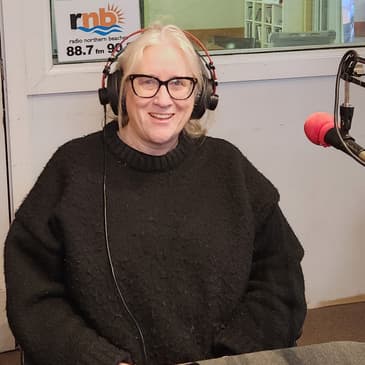
[00:00:00] Hi, I'm Chrissy Mack from Radio Northern Beaches and you've just tuned in to the Listen and Chat with Chrissy Mack podcast. This is the space where we pull no punches, sometimes a little controversial, sometimes downright outrageous and sometimes just packed full of information that is interesting to know. Today I have in the studio with me Stephanie Galloway-Brown and she's one of our local artists and I have her art all over my wall and I'm really proud of it.
[00:00:28] So welcome to Radio Northern Beaches Stephanie. Thank you Christine and thank you for having me today. Now I've got a couple of reasons for having you today. One, you are going to be on the cover of Tawny Frogmouth for next month and you also have an entry in the Archibald and you're also a member of our local artists group. So let's start off with a little bit about you and how you got into art and I'll just say that the reason I met yourself was I was on the Pitwater Trail
[00:00:58] one day and I walked into your studio and you were painting a beautiful King Parrot and I said to you at that time, do not sell that, I want it. Exactly, yes. So that's when I was on the Pitwater Artist Trail which is still running today.
[00:01:13] Although this year is the first year I'm not on it due to being busy and having a show later this year so I'm madly painting for that plus quite a few other things have been happening like the Archibald and it's all been a little bit crazy this year. So yeah, I'm having a break from the Pitwater Artist Trail at the moment so to focus on a few other things. So first of all, so that we don't forget to mention it, tell us about the show you're going to put together.
[00:01:42] Well, the show will be, I'm with an artist collective called Art Gallery on Avalon Beach which will be in November this year. So I'm having a little solo up there which will run, can't remember the dates but check my website because I'll have them on there early in November.
[00:02:01] And it's just more, not portraits, more local scenes, it's called Ebb and Flow so it's kind of about the ins and outs of daily life really and capturing local scenes, interiors, outdoor scenes, garden scenes. So I'm just taking time to paint things I love which has been really enjoyable at the moment so yeah. Yeah, your passion comes out in your paintings I can tell you that. Yeah. Like as I said, I walked in and said I want that straight away.
[00:02:30] So tell us a little bit about yourself, your family. I was born and brought up in New Zealand in a little unknown town at the time called Manamata. My dad was a dairy farmer so we grew up on the farm, my sister and I. We didn't have a lot of contact with other people for the first five years probably of my life until I went to school. Just to, you know, the daily farm life and getting into town very often.
[00:02:59] Yeah, so I was really creative from quite a young age and my mother noticed my drawing ability probably from the age of three or even four when I asked her to draw me a cat. And she said, oh, okay. So she drew me this lovely cat which she thought was lovely, handed it back to me and I looked at it and said, that's not a cat. And she said, well, you draw me a cat.
[00:03:28] So I drew her a cat which was more detailed than her cat. So she was like, oh my God. So she ran out and brought lots of art materials, crayons, papers, scrapbooks and I was kept amused and stocked with. Art supplies the whole time. So I was always the kid drawing, painting in the corner, just, you know, exploring the farm.
[00:03:51] Yeah, just loved nature and my mother had a real love for animals so she really instilled in us a lot about learning about animals and nature. And yeah, so it was a good life growing up on the farm but my parents divorced when I was still young, about 11, I guess. And we stayed living on the farm with my dad and I still spent a lot of time drawing, painting. So I was the arty kid at school.
[00:04:20] And so when did you come across to Australia? I moved over when I was about 20, early 21, somewhere around there. I didn't actually get into art school. I applied to get into art school but I was rejected because I wasn't really very good at maths or anything like that. So I had a lot of trouble at school with maths and in those days the academic side of it was taken as a factor to getting into art school.
[00:04:49] So I gave that idea up and thought, right, I've really wanted to travel. So I went to Australia and started travelling around Australia and lived in Cairns, lived down in Melbourne. Then I travelled over to the UK for two years and travelled all around Europe as we did in our early 20s. And eventually went back to New Zealand but after life running all over the world I couldn't settle down. So I hightailed it back to Australia and saw some friends in Sydney.
[00:05:17] I didn't want to go to Sydney because all the Kiwis go to Sydney. So I went, I'm not going to Sydney but I had some friends here and stopped to see them for a week. I love Sydney so much. I raced back down to Melbourne, packed up all my stuff and moved back to Sydney and fell in love with the Northern Beaches and have lived here ever since. So, yeah. Well, see, that's why they come to Sydney. Exactly. And definitely because they come to the Northern Beaches. Yeah.
[00:05:45] Yeah, it's a wonderful place to live. And so what happened after that? I worked in graphic design and illustration for quite a while. So I had a bit of a career in that and I kind of just evolved organically really where I worked at Macquarie Uni for a while and got involved with the publishing department and ended up in graphics kind of that way and illustrating books. And, yeah, loved it.
[00:06:11] And got to learn everything about computers and computer design which sort of really held my interest for quite a while as well. So I learned a lot about art programs and that sort of thing. So it took me a long time to actually come back to painting.
[00:06:29] And it wasn't until later in life when I had my daughter that I actually really was wanting to get back into the drawing and painting again. So, but there was a funny story about kind of how that happened. My daughter was young and I hadn't painted with oils before, let alone done a huge portrait.
[00:06:54] And at the time I was thinking while she's young I should get some photos done of her. And then I thought, well, we can't really afford that at the moment. Maybe I'll just do a painting instead. So I thought, I'll get a big canvas and some oils. I'd done a bit of painting in acrylic but I'd always wanted to get more involved with learning about oils. So I ended up doing this quite a large portrait of her. And there was a knock at the door and there were some religious ladies doing their rounds.
[00:07:23] You know, and then I turned around and she said, oh, you do painting? When she saw me holding a painting in my hand, can you turn it around and show us? So I turned it around and she said, you've got to enter that in the Shirley Hannon Portrait Awards. It's really good. And I went, are you seriously? Do you think so? So I went, okay. So I kind of, she said the deadline's in two weeks. So get it in. So I went, well, what have I got to lose?
[00:07:52] I might as well give it a go. So I did that and entered it in. And then I got a call from the Bega Gallery to say it had amazingly got selected as a finalist for the Shirley Hannon Portrait Awards, which were down at the Bega Regional Gallery. How exciting for you. That was really exciting because the whole family went down. We did a big trip and, you know, I was hanging there with some, you know, idols. And, yeah, it was pretty exciting.
[00:08:21] So it kind of evolved from there and portrait commissions started coming in. And so I was kind of winging it on the seat of my pants, really. Good way to go. Yeah. Nobody telling you what you have and that can't do. Yeah, exactly. So, yeah, that became my life then. Just, yeah, portraits. And then I decided to do, I got involved with Portrait Artist Australia, which I got into, which isn't running anymore.
[00:08:49] And we had a, we were having an exhibition down in Parliament House, Canberra for Unsung Heroes. And I decided to do firefighters. And I had organised to go down to Victoria through some connections that I knew to paint the firefighters out or a couple of firefighters down there. And at that particular time was when the Black Saturday fires happened, which were really horrendous for Victoria.
[00:09:19] So I left it for a few weeks and then they said, still come down. So I went down and then they took me out. So I sort of saw the aftermath of what had happened and what that all gone through. It would have been rather emotional. Yeah, it was. And then what the volunteers do. I was just, it's just incredible how they put themselves on the line for their love of community, really. And so after doing that painting, I came back to the Northern Beaches.
[00:09:49] I thought, well, there's going to be a lot of other amazing people around the Northern Beaches in my own community doing all sorts of, you know, incredible things. So I went on a mission to find a lot of other volunteers who were doing amazing things and painting their portrait for this project, which I called Face of the Extraordinary Volunteers. And it just became, I ended up doing about 20 to 25 of the small portraits and just made a show.
[00:10:18] But their stories were so incredible. I ended up putting a book together with it as well. It was a pretty big project. So, and there was all sorts. There were wildlife warriors, surfing. There was, you know, meals on wheels, penguin lady, you know, divers. There was, there was so many different incredible things that people were doing for the community. So, yeah, it just became a project in itself. So it was quite enjoyable and I met some incredible people.
[00:10:48] So, yeah. So where can you get a copy of the book? Yeah, you can contact me through my website. There's still a few copies available. And what happens if there's a lot of people that look at it and go, oh, yes, we want one of those. Are you going to do a reprint? Probably not at this stage, no. Okay, so there you go, listeners. You have to get in quick if you want one because there's only a limited amount left. So you married? I did. I did marry and I married Australian.
[00:11:16] So, yeah, there was no chance I was going to get him to go back to New Zealand. And we made our life on the northern beaches. So how did you meet this Australian? Yeah, well, we had been friends for quite a while. So we knew of each other for quite a while. And we sort of were in the same circle of friends. But, you know, it was quite a while before we eventually sort of ended up going, oh, you know, we get on really well. Maybe we should, you know, go out. So, yeah, that's how it happened.
[00:11:45] And so what's his background? He's a plumber. Oh. So, and he has a plumbing business here on the northern beaches. But he doesn't have that anymore. Works for a larger company now. So, and then we have one daughter, the light of our life, Olivia. So she's pretty grown up now, 23. Yeah, so it was a few years ago since I did that portrait of her in her tiger pyjamas for the Shirley Hannon. And I keep trying to paint her again, but she won't let me.
[00:12:14] One lot of notoriety is enough. Yeah. As a kid, did she show any? She was creative in her own ways, but not in an artistic way like I am. She's a lot more, she's clever. She's academic. She's sort of got into more law. And I admire her for the skills that she has that I could never have.
[00:12:41] So she has her own special little gifts, which is good. And does she live close by or is she far away? Oh, she's still at home. Oh, okay. Well, if she's still at home, you two get on, okay? Oh, yeah, yeah, yeah. Oh, that's good. I noticed your studio was underneath your house. Yeah. It's a beautiful big room underneath your house with lots of paintings. Yes, it's quite full at the moment with lots of paintings half done or getting rehashed or, you know, changed around.
[00:13:10] Or, well, you know, I'll take things from downstairs and put them up on a wall upstairs where I can sort of look at them in passing all the time. I'm thinking if something's going to catch my eye, do I need to fix that? Something's not working with that one. What is it? So, yeah, they go through this little motion for a while until I can't wait to get them out of the house and gone. It's funny about that because I bought a painting from one of our art groups. She does beautiful sections of Narrabeen Lakes.
[00:13:40] And when I first went in there, there was a spot. My son lives on Narrabeen Lakes and there was a spot at the end of his street. And this was it. And, you know, it was between the trees. When you looked at it, like when it was a bit darker at the gallery, it looked like the moon was shining across the water. But if it was bright, it looked like the sun was shining. And it fascinated me. But I didn't have the money to buy it that day. So a few weeks later, I went back and I said to the guys, where's the painting?
[00:14:09] Because it wasn't up. And so she brought it back in. But she'd taken the trees off the right-hand side. Oh. And I said, no. Was that the bit you liked? It was the whole lot that framed the scene on the water. Oh. And so she took it back and she painted them back in. And I have it on my wall. But she said that she took the trees off because she thought that's why it wasn't selling. Oh, how funny. And I said to her, no.
[00:14:37] That's what made the painting. It was perfect. It was a spot on you. It gave that reflection across the water and it was framed by the trees, which was what was naturally there. Yeah. So it's funny how you take, I know I was doing a painting of the ballerinas and like, I just can't get the faces. I'm not happy with the faces. So every artist has their little, I don't like that. I don't want to change that. Yeah. But don't necessarily change it because somebody else might like it. Exactly.
[00:15:06] Sometimes you've just got to get the painting away from the artist because they will keep, you know, altering and changing things. I couldn't believe she took them out. And really, a painting is never finished, really. You know, you can just keep changing things, taking things out, putting things in and, you know, it just becomes part of its story. So yeah, grab it. Sometimes you can overdo it. Yeah. Yeah. Or underdo it. Yeah. Anyway. All right. So you now have a painting in the Archibald. I do.
[00:15:36] Yes. This is my second time in the Archibald. I have painted Lane Beachley this year. So she was an amazing subject for me to paint. And I was really lucky that she agreed to sit for me. So I was really grateful. Yeah. So that's been a whole, very big, quite a full-on experience this year. So we've had to do a few talks at the gallery, which was a little out of my comfort zone.
[00:16:04] But I've probably done about three in there now, but I'm getting better as they go. But the Archibald is nearly at the end now. So I think there's another two weeks left. And it finishes up on the 16th, I think, of August. And then it travels off around other regional galleries for the next year. So I was lucky enough to get a big banner as well, have a banner of Lane hanging outside the front of the gallery. So that was pretty exciting as well. Yeah.
[00:16:34] Yeah, it's been pretty exciting. So I was in the Archibald about two years ago with also a local artist, Catherine Longhurst, who I painted for that one. Both were great experiences, but both quite different, which, yeah, has been interesting. So I think that painting will be on the cover of the Tawny Frogmouth. Okay. Well, looking forward to seeing that. So how did you come to paint Lane?
[00:17:01] I was lucky enough to bump into a friend of mine who knew Lane because I didn't know Lane before. I painted her, but thought that she would be a great subject, not just because of her incredible sporting achievements, but also because of all the work she's doing for Awake Academy and mental health and helping people achieve their own dreams. So she's sort of on this whole other trajectory now of helping people, which is really lovely.
[00:17:30] And I bumped into a mutual friend we had at Coles doing the shopping. And I said, oh, do you think? And it was before, I think I had about three months before. And I thought, I better get organized this time. And it was just opportunity that I bumped into our mutual friend. Thank you, Carol Gibbons, photographer at Eleonora. And she said, oh, okay. You know, and she put us in contact. And so I spoke to one of Lane's assistants and she said, well, I'll put it to her.
[00:18:00] You know, she's been painted before. I'm not sure if, you know, she doesn't usually do the archibald. So I said, oh, well, this is who I am and what I do. And, you know, maybe just wave it under her nose and see if nobody else is painting her this year, see if she'll be interested. Anyways, so then she got back to me in a couple of weeks and said, oh, wow. She said yes. And I went, oh, wow. Oh, no, there's no backing. How exciting. How wonderful. There's no backing out now. I've really got to go through with it.
[00:18:27] So, yeah, it can be quite difficult contacting people sometimes to, you know, it's a weird thing asking to paint someone's portrait. You never. It's very personal. It is. Yeah. And you never know whether, you know, they're going to say, oh, no, I don't think so. Or, yeah, it's a bonus if they say yes. So, you sort of, there's a little bit of a risk of, you know, not rejection, but it's just kind of, yeah, you know, you're putting yourself out there a little bit. So, and artists always find it a little bit difficult. Yeah.
[00:18:57] So, I was pretty grateful. And then she came to my studio and for the sitting for the Archibald. So, and it just went on from there. And then, amazingly, the painting got in. And, yeah, so we sort of went on this journey of doing talks together and whatever. So, at the gallery. And so, it's been an amazing experience. And now it goes on its little, it's in the gallery on a little life of its own now. And then it's off around, down to Victoria next. And I think it ends up at Tweed Head.
[00:19:26] So, it's going to be all over the place for a little while yet. So, which will be lovely. Anyway, I've got to think about other work now. So, yeah. Well, thank you so much for coming in and talking to me, Stephanie. It's been wonderful just learning about your journey. And I love my birds. Just walking into my house and seeing these two huge birds on the walls. Everybody comments. Everybody says how beautiful they are. Thank you. Thank you, Christine.
[00:19:53] If anybody wants to look at my work, they can see my website at gallowaybrown.com.au or my Instagram, which is Stephanie Galloway Brown. Or you can find me up at the Art Gallery on Avalon Beach with a few of the other lovely artists that are up there. So, come and visit. And I've always got something hanging up there so that you can see. Excellent. And your show's in November? November. Early November. We'll keep an eye out for that. Yep. Excellent. And the dates are on my website. So, yeah.
[00:20:23] Terrific. All right. Thank you so much. You're talking to Stephanie Galloway Brown on Radio Northern Beaches, 88.7 and 90.3 FM. Also streaming on rnb.org.au around the northern beaches across Australia and all over the world. So, thank you for joining us. Don't forget to follow, like and share. Stay safe and I'll catch you next time.