
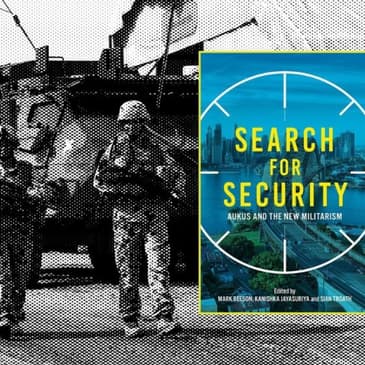
[00:00:00] Hi, I'm Chrissy Mack from Radio Northern Beaches and you've just tuned in to the Listen and Chat with Chrissy Mack Podcast. This is the space where we pull no punches, sometimes a little controversial, sometimes downright outrageous and sometimes just packed full of information that is interesting to know. Today my friend and fellow presenter Michael Lester is talking to Professor Mark Beeson about AUKUS militarisation. So let's have a listen.
[00:00:28] Our program today is Community Voices and I'm Michael Lester. We've currently got visiting in Australia the Canadian Prime Minister Carney, who very recently has very clearly stated what a lot of us know is happening in geopolitics and globally, namely that we've come to the end of the post-war rules-based international order led by the Americans.
[00:00:51] If we need any more demonstration of that, we've only got to look to what's been happening to World Trade and the World Trade Organisation processes with Trump and his tariff wars. And now, of course, we have the UN and the question of war, particularly with the American intervention and war to Iran.
[00:01:09] These developments in the global geopolitics have huge implications for the world and the way it operates for its safety, its security and its wealth, if you like, and prosperity, not least for Australia that's relied on international-based rule order for our prosperity and security. I'm pleased to be welcoming to our program, Professor Mark Beeson, co-editor of a book, Search for Security, AUKUS and the New Militarism.
[00:01:36] It's been published by Melbourne University Press and it's over 300 pages of diverse and different perspectives from 15 or 16 authors on these key questions of geopolitics through the lens of AUKUS. Mark is adjunct professor these days at the University of Technology in Sydney, the Australia-China Relations Institute. He's worked as a professor at the University of Western Australia. He's been at Murdoch, Griffith, Queensland and also in universities in England, in York and Birmingham.
[00:02:04] He's a political scientist who specialises, I believe, in geopolitics and geoeconomics and their intersection and particularly implications for Australia. And our policy is a prolific author, many articles, much cited, many books. Thanks very much, Mark, for joining us on Radio Northern Beaches. My pleasure. Mark, Search for Security, AUKUS and the New Militarism. Why, at this point, have you thought it useful and important to bring together this book on this topic?
[00:02:33] I believe part of it you speak about is the need to widen the debate on AUKUS and that in many ways we've been sleepwalking into the issues of militarism. So what's the motivation and objective of the book at this time? Well, I think the reasons that you say that hasn't really been much of a debate about AUKUS. And given that this is the biggest and most expensive project in the nation's history, you would think there would be.
[00:03:01] But if you remember, when AUKUS was initially thought up, it was sort of an idea of Scott Morrison's. And he, I think, with an eye on the forthcoming election in 2025, thought this might be a way of wedging the Australian Labour Party on an issue they didn't want to look weak on. Because security is something that all political parties think is their first obligation to the nation and the population.
[00:03:27] And so looking weak on security and inverted commas was something that the Labour Party couldn't risk doing. And so consequently, this astounding initiative was waved through by the Labour Party because they didn't want to look weak. And if we remember who was the brainchild behind it, I mean, Scott Morrison from Australia, who's now one of the most discredited figures in Australian politics. I think that there is arguably the worst prime minister we've ever had in the face of a bit of stiff competition.
[00:03:56] But also Boris Johnson. I mean, he's not covered himself in glory either. And Joe Biden. So you would think with a list of supporters like that, there would at least have been some discussion within the Labour Party, if not within the wider public of which we are all apart.
[00:04:14] So, you know, a number of colleagues and myself thought we should really try to encourage wider debate about these issues, because there is an informed and literate public out there that are interested in these kinds of debates or the absence of them. And we thought we should try and do something about laying out some of the big questions that are just not being really ventilated in the way that they ought to be.
[00:04:39] So it was partly sort of therapeutic, I think, for the authors and editors just to get it off their chest and try to make a contribution, even if we imagine that policymakers in Canberra will studiously ignore it. Why is it important to take a look at the AUKUS arrangements, the most expensive commitments we've ever made to our defence, of course? Why is it important to look at those developments through the lens of what you in the book are calling the new militarism? And what is the new militarism?
[00:05:09] Well, it's a phrase that tries to capture the idea that some proposals, some relationships, some ways of thinking about the nature of security become naturalised and uncontroversial.
[00:05:22] The more that they become a familiar part of the sort of national discourse and that powerful people in politics, the strategic community promote certain ways of thinking about things so that the links between politics and military developments, military policy, strategic policy, they become closer and more taken for granted, I think.
[00:05:45] And so the idea that huge spending on military hardware might be uncontroversially part of the so-called national interest becomes more or less taken for granted. Certainly it does amongst the policy elites in Canberra, who can imagine no other way of behaving other than the sorts of things that they're supporting in AUKUS. That's an interesting aspect of this.
[00:06:10] But I think more generally, when senior officials and policymakers seem to be on a unity ticket about the importance of certain military issues and ways of thinking about our strategic position in the world, then it becomes much easier for them to sort of wave these kinds of mega projects through without any consultation or real scrutiny or even cost benefit analysis as becoming clearer as every day goes by.
[00:06:39] I think in your work, you speak and utilize the concept of path dependencies in shaping alliances and how they frame and shape them and perhaps limit them, particularly with respect to middle powers like Australia in difficult shifting times. Part of the discussion in your book turns on our heritage here with the Anglosphere and what you call the new strategic Orientalism.
[00:07:02] So why is the Anglosphere a significant factor in what's happening with our positioning strategically with AUKUS? The relationship with the United Kingdom, of which we're a former colony, of course, and other similarly positioned countries like Canada, New Zealand, and of course, the United States.
[00:07:22] There's a sort of, as far as some people are concerned, a sort of natural affinity, a common culture, if you like, that unites these countries together because they have similar values, their democracies, and they have this common cultural inheritance, which makes it almost natural that they would choose to partner with countries that they have these longstanding relationships with ahead of others.
[00:07:49] So that's part of the background for this, the influence of the so-called Anglosphere, this common sort of culture. But I think in Australia's case, it's powerfully reinforced by the fact that Australia is a long way from these kind of quote-unquote natural allies, apart from New Zealand, obviously. But the mother country is a long way away. The Americans are a long way away.
[00:08:14] And Australia policymakers have traditionally seen themselves as being in an uncertain region, surrounded by countries that they don't always understand terribly well, that they haven't had longstanding deep relations with. So there's always been a sense of anxiety about our place in the world and about the best way of trying to ensure our security. And security in this case is meant in a fairly narrow way.
[00:08:43] That's all about guns and bombs and threats from other countries who might want to do terrible things to us. So there's a fairly stereotyped view of both our cultural inheritance and the sorts of threats that we might face in being a sort of stranger in a strange region, if you like. So that's been part of the heritage, I think.
[00:09:06] And part of the heritage effect presented in the collection of articles in your book is that this might lead suboptimal strategic discussions and commitments, like in this case, it's argued, the August nuclear submarines. But in part, too, we've always relied, as you said, for our security on our great and powerful friends and latterly and currently the Americans. And yet there's a pointing here to what's said to be America's exhausted strategic imagination.
[00:09:34] So what's driving our partners and our heritage down this path? Well, that's a good and complex question. It varies. I think Biden had an idea of reinforcing America's strategic primacy in the world and linking that to domestic industry policy to try and revitalize American manufacturing and make it more capable of responding to fairly conventional types of security threats,
[00:10:02] which these days, of course, emanate primarily from China. And this is a bit awkward, of course, because China is nearly everybody's biggest trade partner these days. And that's especially true of us. So it sort of complicates the question. As far as Australia is concerned, I think there was an enthusiasm to lock themselves into this kind of emerging new agenda
[00:10:26] where America was seeking to reassert itself as the kind of dominant power in this part of the world and possibly just the world generally. I think the dangers of moving in lockstep with the United States without having much of a debate about the strategic or political implications of doing so has been revealed by the fact that we have a new president now, of course, who's taken over from Biden.
[00:10:54] And he is adopting a much different, more aggressive, more unilateral, more assertive view of America's role in the world and America's right to behave as it wishes to and to flag international law and the famous rules based international order if it judges it to be in its best interest to do so. Now, clearly, this is a major problem for a so-called middle power like Australia,
[00:11:23] because we rely on the existence of a so-called rules based international order to allow our economic integration to take place, to give some predictability and possible certainty to an external environment over which we have very little control with or without these submarines.
[00:11:45] And so the rules based international order offered one way of trying to make that external environment more predictable, more secure and something we could rely on. Now, with the emergence of Donald Trump, who's got no respect for international law or much else we could reel off as well, all of those assumptions about the way the world works, about Australia's position in it,
[00:12:11] about the protection of the so-called rules based international order. I think they've just gone straight out the window. And that's the importance of Mark Carney's speech that you mentioned earlier on, I think was the proverbial wake up call or should have been for many countries around the world, including Australia,
[00:12:29] because he highlighted the fact that in a world where Mike makes right and the United States can just use its formidable military capability to get its own way. And this is bad news in the long term for middle powers, because there's nothing to say that Trump won't leverage and lean on some of his opposed allies in the way that he's been condemning Europe for not spending enough on defense,
[00:12:57] in the way that he's been leaning on key allies like Canada even and threatening to take it over. I mean, it really is a very troubling moment in the world at the moment. And the fact that most of the trouble is being caused by the United States is something of an indictment of Australian policy and the thinking that's underbinded for so long. Our guest here on Community Voices Radio in Northern Beech is Mark Beeson,
[00:13:25] the adjunct professor at the University of Technology, Sydney, the Australia-China Relations Institute. We're talking about a book he's co-edited, Search for Security, AUKUS and the New Militarism. The politics of our alliance with the US poses a strategic dilemma, as the book discusses. There are a number of mythologies and strands to this, but one of the mythologies that seems to be here is about the Indo-Pacific that seems to be playing a role here.
[00:13:51] And as you've mentioned, the book refers to Australia being a disoriented nation and refusing to accept the strategic centrality of China. Yes, well, I think that's the sort of thing we were sort of briefly touching on earlier on, that geography determines a lot in international relations. And the fact that we are where we are is going to be a reality forever.
[00:14:15] My view is that we should recognize that our principal strategic relationships and possible, quote unquote, threats are likely to be in the immediate region where we live, but so are major economic opportunities. And so is the possibility of redefining some of those relationships with our regional neighbours as well.
[00:14:40] But this idea of disorientation refers to the fact that it's difficult for Australian policymakers in particular to balance this unthinking commitment towards the United States and the belief that they are the only thing that's going to keep us secure from the idea that we live in a region that is going to be dominated by China. I just don't think there's any doubt about that. And the question is, what do you do with it? Do about that.
[00:15:06] What we've chosen to do is to double down on deterrence and to make ourselves part of the Americans' grand strategy in the region and the world and to spend an awful lot of money shoring up our position with the Americans. The problem with this strategy, I think, is that if China isn't deterred by America's overwhelming military force,
[00:15:33] they're hardly going to be influenced by us, whether we have five, six or seven nuclear powered submarines one way or the other. It's just not going to make a big difference to their strategic calculations in Beijing. What it does do, of course, is to lock us into whatever it is that the Americans think is a good idea at any particular time.
[00:15:55] So this notion of interoperability, where we have a seamless relationship with American defense capabilities, the existence of American bases and military assets across an increasing number of parts of Australia. This reinforces the idea that we're not really a serious part of this region.
[00:16:20] We're still clinging to the coattails of the United States who are not part of this region. So a number of people are beginning to argue, not before time in my view, that maybe we need to have a serious rethink about our place in the world literally and to think of more appropriate diplomatic and strategic relations that might reflect that reality,
[00:16:45] which is simply not going to go away and which looks a more secure and stable region compared to North America under Trump's leadership and the countries that he decides to unilaterally pick on because he thinks it's in America's national interest. So I think there's a real tension at the heart of Australia's foreign and strategic policy that's unresolved.
[00:17:12] And it's partly unresolved because we've never really had a mature discussion about this that actually involves the Australian people and gives the government and the opposition, for that matter, a chance to actually explain themselves in a way that answers some of these fundamental questions. We've previously, Mark, over the last couple of decades or so, heard quite a bit in the context of Australian foreign policy and what have you about the Indo-Pacific region.
[00:17:41] But in the book, this is discussed as a mythology that's exclusion, an exclusionary order. What's the significance of this terminology and concept for us of the Indo-Pacific? Yes, it's an interesting development. And I think that the idea was basically to make Australia seem more significant in a way,
[00:18:01] to draw in India and the Indian Ocean as part of this way of thinking about our strategic and geographical place in the world. So there was a couple of motivations, I think. One was to put Australia right at the centre of the geopolitical map by rebadging it as the Indo-Pacific. And the other idea, of course, was to try to ensure that the Americans remain engaged in the region, whatever it's called.
[00:18:31] And I think the Americans were happy to go along with this because the Indo-Pacific, I think, is unambiguously also a way of placing China at the centre of this kind of evolving geopolitical space, whatever you call it, because it's at the centre of the Indo-Pacific, along with Australia. And it's clearly the Indo-Pacific, that is, and the relationships like the Quad, AUKUS,
[00:18:58] those relationships are clearly aimed at deterring China from acting aggressively, which there's a debate to be had about that, about how effective it is or necessary it is. But it's also a way of making sure that the kind of strategic relationships that are evolving around this concept of the Indo-Pacific are designed to stop China from asserting itself
[00:19:25] in the region and trying to establish alliances or relationships that will deter China and make this unlikely. And trying to incorporate India into this might be understandable as part of the so-called Quad nations, whether they're going to be a reliable partner, whether they're just going to ditch their own relationship with China, which has been problematic but is important to them.
[00:19:49] That's an open question and it's not at all clear that just because you start an organisation like AUKUS or the Quad, that certain things will follow it and that the United States will be a reliable partner in those relationships and live up to its expected obligations as the kind of defender of last resort, if you like. So under a Trump presidency, and maybe anybody who follows him,
[00:20:16] that certainty or expectation about the way that the United States will behave is a lot less certain and clear than it ever was. Mark Beeson is the co-editor of the book we're discussing here on Community Voices Radio Northern Beaches, which is the search for security, AUKUS, and the new militarism. This all sort of reflects the shortcomings of an Australian, I think it's called strategic imagination, that we can't seem to think our way out of this path that we've been following and become locked into.
[00:20:46] AUKUS affects all parts of Australian society and community. You also consider the ALP political approach. It's been characterised in the book as a profound crisis of representative democracy. I think the fact that we haven't had a real debate about this, the public has not been invited to take part in any discussion of what is the single biggest expenditure in the nation's history.
[00:21:14] And there's an awful lot of chat about this is a nation building project, and it's going to be good for industry and there'll be more investment and blah, blah, blah. All of those things are up for debate. And if we're going to spend an awful lot of money on something, I mean, I personally can think of far better things that we could spend that money on that will make a real difference. And this is what's interesting about the domestic political aspects of this.
[00:21:40] If we're spending $368 billion on submarines, that's $368 billion at least that we don't have to spend on other things. For example, making a green transition, rewiring Australia, building social housing that's absolutely vital. And it's shameful that it doesn't exist in quite the way that it should. In terms of the Australian Labour Party in particular, this is again a bit of an indictment of their priorities,
[00:22:10] because some of us might expect that a supposedly progressive left-wing political party would have those kinds of ideas about social equity, about the importance of opportunity costs and the fact that you can't spend money twice on different things. You would think that they would be top of their political agenda and something that they would be thinking about as a priority.
[00:22:36] Whereas, in fact, they are placing their bets on the importance of a strategic alliance with the United States, which is debatable in itself. But the problem about the AUKUS project, I think, is that many, many experts now, including people who've, in the military, in former members of the military, former submarine captains, Rex Patrick,
[00:22:59] other people, have all come forward to say that even if you think having a submarine capacity for Australia is a good idea, and there's a debate about that, but even if you think we really need them for some reason, there are much better, cheaper ones that we could have bought. We could have them in operation already if they're so vital, whereas I would argue it's unlikely that these nuclear-powered submarines will ever arrive,
[00:23:26] because the Americans can't build enough for their own purposes, and the British shipyards are in a mess, so we're not likely to get money from there either. So the whole project is just unbelievably ill-conceived and a waste of money, in my view, and the money could have been spent on much better things, particularly by a Labour government, which has unfortunately become hostage to this desire to ingratiate itself with Americans,
[00:23:55] because that's the only way they can think of keeping us, quote-unquote, safe. And Richard Miles is the quintessential example of how far this kind of sycophancy towards the United States has gone, and I'm not sure that Richard Miles actually realises which government he's representing in some of these talks. We hear a lot in our political debates on a reasonably broad front, but including on defence and security and immigration, about national values.
[00:24:21] AUKUS has been described in your book as a militarised form of neoliberalism. I'm wondering what are the social and social cohesion potential implications of this? The most obvious problem with this emphasis, particularly in conjunction with the so-called China threat, is that the increasingly large Chinese diaspora in Australia feels understandably a bit nervous,
[00:24:46] a bit alienated, and a bit victimised by some of the discourse that circulates around this kind of idea about the so-called China threat, which has been, I think, shamefully amplified by things like the Red Alert series in the Australian Financial Review a couple of years ago. I mean, it's just indefensible in my view.
[00:25:07] But yes, I think those kinds of questions about the sort of impacts of large strategic decisions on the general population is something that's not taken seriously, because the main focus in this kind of neoliberal militarisation is the business opportunities that are available to various companies.
[00:25:32] And where I live in Western Australia, there's huge excitement amongst potential providers of skilled services for the rebuilding project of the Garden Island base and for many of the other associated industries and suppliers that will hope to benefit from this. So I think the problem is that political interests and decisions and economic interests are becoming fused in a common agenda
[00:26:02] of there's lots of money to be made in the AUKUS project, lots of business opportunities, and the wider strategic significance, the blow to intergenerational justice that this represents when private sector interests are being prioritised over the interests of the wider community is a real problem, I think, particularly when we've never had a debate about the rationale for the AUKUS project
[00:26:29] or the costs of not being able to do other things with the money that we're spending on the sub. So I think we just desperately need this kind of debate. Mark, a number of the chapters in your book do address the question in terms of the balance sheet of insecurity, and you've spoken of militarism, in fact, and the costs of the path we're treading with AUKUS and the very important idea of opportunity costs for the society.
[00:26:56] But there are some implications in the context of our sovereignty too, are there? An argument that what we're doing here in Lock 2 is, in a sense, diminishing our sovereignty and our scope to develop policies in the future that tread a different, more peaceful, more deliberative, diplomatic world rather than an offensive, militaristic approach? Yes, I don't think there's any doubt about the fact that our sovereignty will be negatively affected by this particular development.
[00:27:23] I mean, I think our relationship with the United States has done that for quite a long time. And maybe it's a good thing that the idea of domestic sovereignty has come to the fore a bit in this kind of context. And it's interesting that Malcolm Turnbull, for example, has talked very eloquently about the dangers to our national sovereignty and the fact that we won't have decision-making capability about the most fundamental issues you can possibly think of, i.e. going to war.
[00:27:53] For example, if there is a conflict between the United States and China, and there's no guarantee at all that the United States will come to Taiwan's aid if China behaves aggressively towards it, there's absolutely no doubt that Australia, as ever, will rush to Australia's aid and do its bit as a loyal alliance supporter without any discussion or even any thought about doing anything different.
[00:28:20] Unfortunately, that's not a sovereignty-shrinking kind of idea. It's hard to know what is, really. So, yes, there are profound implications for this, but I think we need to realise that some people make either a political or an economic judgment that it's in their interests, even if it's not in the much-discussed national interest. Thank you, Mark. As we wrap up here with Mark Beeson, co-editor of the book Search for Security, AUKUS and the New Militarism,
[00:28:48] one of your final contributors speaks of AUKUS and militarism being a mindless distraction from the things that matter and makes a call for, quote, a human security-based approach, which is a very resonant idea that reflects much of what you've been talking about here today. So thank you very much, Mark Beeson, for joining us on Radio Northern Beaches. No, my pleasure. Thanks for having me. All right. I hope I've given you a lot to think about and talk about and debate and maybe disagree with.
[00:29:17] Don't forget to follow, like and share. Stay safe and I'll catch you next time.